



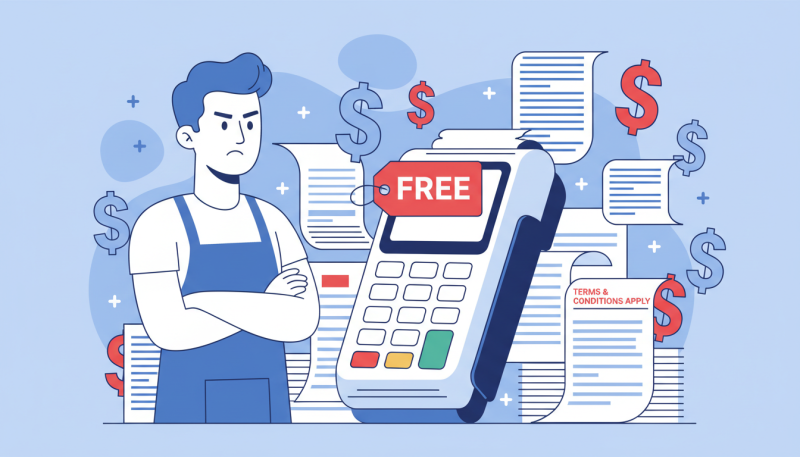
You walk into a merchant services meeting. The sales rep slides a sleek card terminal across the table and says, “It’s yours — completely free.” Sounds like a win, right? For most small business owners, that word “free” is almost impossible to resist. But here’s the uncomfortable truth: understanding free equipment offers in merchant services could save you thousands of dollars over the life of your contract. What does free credit card processing equipment really mean? More often than not, it means you are paying — just not upfront, and not in ways that are easy to spot. This guide breaks down exactly how these offers work, what the real costs look like, and how to choose a payment processor without falling for free terminal offers that cost far more than advertised.
What Does “Free” Actually Mean in Payment Processing?
When a merchant services provider offers you a free POS terminal or credit card reader, they are not handing over a gift. They are making a business decision. The hardware cost — which can range from $200 to over $1,000 for advanced terminals — does not disappear. It gets absorbed somewhere else in your agreement.
What does free credit card processing equipment really mean in practical terms? It typically means one of three things. The provider buries the equipment cost inside inflated processing rates, they lock you into a long-term contract with steep early termination fees, or they technically retain ownership of the hardware while you pay monthly service fees to use it. None of these arrangements are inherently fraudulent, but all of them require very careful reading before you sign anything.
Are free payment processing terminals truly free? The short answer is no. The longer answer is that the cost structure is simply rearranged. A standard payment terminal might cost a processor $250 to purchase wholesale. If they charge you even 0.10% more per transaction on a business processing $30,000 per month, they recover that hardware cost in under 12 months — and continue profiting from the inflated rate for the remainder of your contract.
How Free POS Equipment Offers Work in Payment Processing

How free POS equipment offers work in payment processing follows a fairly predictable formula. The processor attracts you with the hardware offer. Once you are engaged, the conversation shifts to rates, fees, and contract terms — which is where the real money is made. By the time you are weighing processing fees, the “free” terminal feels like a bonus rather than a red flag.
The mechanics usually involve a tiered pricing model or a flat-rate structure that is set slightly higher than the market average. Some providers use a non-cancellable equipment lease disguised as a free offer. This is one of the most important distinctions in the difference between free equipment offers and equipment leasing fees. With a lease, you may end up paying $40–$80 per month for three to four years on a terminal worth $300. That is potentially $3,840 for a piece of hardware you could have bought outright for a fraction of the price.
The table below summarizes how hidden costs are typically distributed across different “free” equipment offer structures:
| Offer Type | How You Actually Pay | Estimated True Cost Over 3 Years |
|---|---|---|
| Free terminal with inflated rate | Higher per-transaction fees | $1,200–$3,600+ |
| Free terminal with long-term contract | Early termination fees if you leave | $300–$750 in penalties |
| Equipment lease disguised as free | Monthly lease payments | $1,440–$2,880 |
| Free terminal with monthly service fee | Recurring monthly charges | $720–$1,440 |
Hidden Costs Behind Free Payment Terminal Offers
The hidden costs behind free payment terminal offers are not always buried in obscure clauses. Sometimes they are written plainly in the contract — but in language designed to be skimmed rather than studied. How merchant agreements hide costs behind free equipment offers is a documented practice in the industry, and consumer advocacy groups have flagged it repeatedly. The Federal Trade Commission’s guidance on deceptive pricing is a useful reference for any business owner trying to decode whether a deal is genuinely transparent.
Common traps in free credit card machine deals include automatic contract renewals that lock you in for another year without notice, PCI non-compliance fees charged monthly even when you are compliant, statement fees, batch fees, and annual fees that collectively add $30–$60 per month to your bill. How free terminal offers hide higher processing fees is often achieved through rate structures that look competitive on the surface but apply only to the most ideal transaction types. Keyed-in transactions, rewards cards, and corporate cards all get downgraded to higher tiers, quietly eroding your margin.
What small businesses should avoid in free merchant equipment offers comes down to one discipline: never evaluate the terminal offer in isolation. Always calculate your effective processing rate across your actual transaction mix before agreeing to any deal.
Free Equipment Offers vs. Paid Terminals: A Real Cost Comparison

The free payment processing equipment vs paid terminal comparison is more nuanced than most sales reps will admit. Paying outright for a terminal — or choosing a processor that uses interchange-plus pricing with no equipment subsidy — often delivers significant long-term savings. The real cost of free vs paid payment terminals depends heavily on your monthly processing volume and average ticket size.
| Scenario | Monthly Volume | Free Terminal Deal (Rate: 2.9%) | Paid Terminal + Lower Rate (2.4%) | 3-Year Difference |
|---|---|---|---|---|
| Small café | $15,000 | $522/mo | $360/mo + ~$8/mo terminal | $5,544 saved |
| Retail boutique | $40,000 | $1,160/mo | $960/mo + ~$8/mo terminal | $6,912 saved |
| Service business | $10,000 | $290/mo | $240/mo + ~$8/mo terminal | $1,512 saved |
The pros and cons of free POS terminal offers from merchant providers are real on both sides. For a brand-new business with zero startup budget, a free terminal eliminates an immediate capital expense. That is a legitimate advantage. However, for any business processing more than $10,000 per month, the math almost always favors buying or leasing a terminal independently and negotiating for the lowest possible processing rate. Comparing free card readers vs full service merchant accounts reinforces this: full-service accounts with transparent pricing structures almost always outperform bundled “free hardware” deals over a 24–36 month window.
Are Free Credit Card Readers a Scam or a Legitimate Offer?
Are free credit card readers a scam or legitimate offer? This is a fair question, and the honest answer is: both exist. Not every free equipment offer is predatory. Some processors — particularly newer fintech-driven companies — genuinely subsidize basic hardware as part of a competitive strategy without layering on deceptive fees. But the market is also crowded with providers who use free hardware as an entry point for aggressive upselling and long-term lock-in.
Myth vs reality in payment equipment promotions looks like this: the myth is that free equipment is a sign of a generous, customer-friendly processor. The reality is that equipment is one of the cheapest parts of the payment processing business. Giving away a terminal is trivial compared to the revenue generated over a multi-year merchant agreement. What small business owners need to know about free POS terminals is that the terminal is almost never the most important variable in the deal. The processing rate, the contract length, and the fee structure are what define whether the relationship benefits your business.
How to identify hidden contracts in free payment processing deals requires asking specific questions before you sign. Ask for the contract length in writing. Ask whether the equipment is owned or leased. Ask what happens to the terminal if you cancel early. Ask for a complete fee schedule, not just the headline rate. If a sales rep is evasive on any of these points, treat that as a significant warning sign.
Payment Processors With Honest Equipment Policies
The good news is that payment processors with honest equipment policies do exist. Several companies in the market have built their reputations on transparent pricing and ethical practices. NerdWallet’s guide to the best merchant services provides regularly updated comparisons that include fee transparency ratings — a useful starting point for any business evaluating providers.
Square
Square is one of the most recognized names in straightforward payment processing. Their free card reader for new merchants is genuinely free for the basic magstripe model, and their pricing is flat-rate and publicly disclosed. There are no long-term contracts and no early termination fees. The tradeoff is that their flat rate of 2.6% + $0.10 per swipe may be higher than interchange-plus pricing for high-volume businesses.
Stripe
Stripe operates primarily as an online payment processor but also supports in-person payments through its Terminal hardware. Pricing is transparent and interchange-plus options are available for qualifying merchants. Stripe does not use free hardware as a sales tactic, which makes it a strong example among best transparent payment processing companies without hidden fees.
Payment Depot
Payment Depot is a membership-based processor that charges a flat monthly fee and passes interchange costs directly to the merchant. It is one of the clearest examples of low-cost card processing solutions with no free equipment gimmicks. Merchants pay for their own hardware upfront, but the savings on processing rates more than compensate at moderate to high volumes.
The table below offers a quick comparison of these providers on the key variables that matter most:
| Provider | Equipment Policy | Contract | Early Termination Fee | Pricing Model |
|---|---|---|---|---|
| Square | Free basic reader | Month-to-month | None | Flat rate |
| Stripe Terminal | Hardware purchased | Month-to-month | None | Interchange-plus |
| Payment Depot | Hardware purchased | Annual membership | None | Membership + interchange |
| Typical ISO Reseller | “Free” terminal | 3-year contract | $250–$500 | Tiered (non-transparent) |
How to Choose a Payment Processor Without Getting Burned
How to choose a payment processor without falling for free terminal offers starts with reframing the conversation entirely. Stop evaluating the hardware and start evaluating the total cost of acceptance — the complete percentage of revenue you surrender to processing across all transaction types and fees. This number is what actually determines how much payment processing costs your business each year.
Guide to understanding free payment processing equipment offers in plain terms: if a provider leads with the hardware, ask what they are not leading with. Request an interchange-plus quote. Ask for a sample month statement from a comparable business. Check the Better Business Bureau and independent review platforms for patterns of complaints about hidden fees or contract disputes. The Nilson Report covers payment industry trends and is a credible resource for understanding how processor economics actually work.
Ethical merchant service providers for small businesses are identifiable by a few consistent traits. They publish their rates online without requiring a sales call. They offer month-to-month agreements or short initial terms. They do not charge early termination fees. They use interchange-plus or membership pricing rather than opaque tiered models. These characteristics should serve as your checklist when evaluating any provider — with or without a free terminal offer on the table.
Conclusion
The truth about free card processing equipment for small businesses is straightforward: the hardware is rarely the gift it appears to be. Every “free” terminal offer is underwritten by something — higher rates, locked-in contracts, monthly fees, or equipment leases that inflate your costs for years. That does not mean you should automatically reject any provider offering free equipment. It means you should read every line of the agreement, calculate the total cost over the full contract term, and compare it honestly against alternatives where you pay for hardware upfront but benefit from lower processing rates.
What to know before accepting free credit card machine offers is ultimately this: the word “free” in payment processing is a marketing term, not an accounting one. The most expensive terminal in the room is often the one with the biggest FREE sticker on it. Know your numbers, ask the hard questions, and choose a processor whose business model is built on keeping you as a long-term customer — not locking you into an agreement you cannot afford to leave.
Frequently Asked Questions
Q1: What does free credit card processing equipment really mean for my business?
It means the hardware cost is recovered through other parts of your agreement — typically through higher processing rates, monthly service fees, or long-term contract obligations. The terminal itself is rarely free in any economic sense. Always calculate the total cost of the agreement, not just the upfront hardware expense.
Q2: Are free POS terminal offers always a bad deal for small businesses?
Not always. For a brand-new business with minimal startup capital, a free terminal eliminates an immediate expense and lowers the barrier to accepting card payments. The deal becomes problematic when the inflated rates or restrictive contract terms cost more over time than simply purchasing the hardware outright. The key is doing the math before you commit.
Q3: How can I identify hidden contracts in free payment processing deals?
Ask your sales rep directly for the full contract term, the equipment ownership structure, and the complete fee schedule in writing. Look for auto-renewal clauses, early termination fees, and PCI compliance fees. If the provider cannot or will not provide a full written breakdown before signing, that is a clear signal to walk away.
Q4: Which payment processors offer truly transparent pricing without free equipment gimmicks?
Square, Stripe, and Payment Depot are three examples of providers with publicly disclosed, straightforward pricing models that do not rely on free equipment promotions to attract merchants. For high-volume businesses, interchange-plus processors and membership-based models consistently offer the most honest total cost of acceptance.