




A merchant account is a specialized type of bank account that allows a business to accept and process card payments — credit cards, debit cards, prepaid cards, and digital wallets such as Apple Pay or Google Pay.
Unlike a standard business bank account, a merchant account is not where your money lives permanently. It is an intermediary holding account, operated by an acquiring bank (also called an acquirer or payment processor), where card payment funds are temporarily parked after authorization and before being swept into your main business bank account — typically within one to three business days.
Table of Contents
Think of it as a transit lounge for your revenue: every card payment lands there first, fees are deducted, fraud checks are run, and then the net amount is transferred to you.
| Key distinction: A merchant account is NOT your bank account. It is a contractual relationship with an acquiring bank that enables you to participate in global card payment networks. |
Merchant account vs business bank account — key differences
| Feature | Merchant Account | Business Bank Account |
| Purpose | Process card payments | Hold and manage business funds |
| Operator | Acquiring bank / processor | Commercial bank or credit union |
| Funds held for | 1–3 business days | Indefinitely |
| Who controls it | Subject to processor risk rules | You control entirely |
| Required for | Accepting card payments | All business banking needs |
| Can you spend from it? | No — it transfers to bank | Yes |
| Monthly fees | Usually yes ($0–$99+) | Often yes ($0–$30+) |
| Contract length | Month-to-month or 1–3 years | Usually at-will |
Why every business that accepts cards needs to understand this
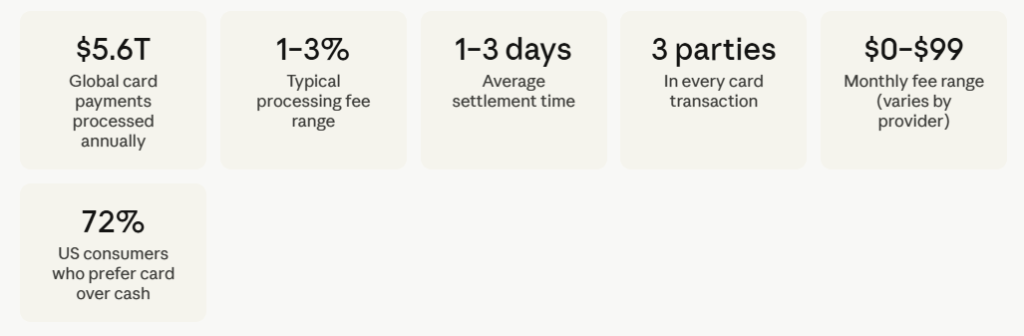
Even if you use Stripe, Square, or PayPal — you are using a merchant account. These providers act as payment aggregators, meaning they pool thousands of small businesses under their own master merchant account with the card networks. Understanding how merchant accounts work lets you:
- Negotiate better rates as your volume grows
- Understand why chargebacks happen and how to prevent them
- Know your rights when funds are held or accounts are terminated
- Make an informed decision between aggregators and dedicated accounts
- Budget accurately for payment processing costs
Section 2: How Card Payments Work — The Full Journey
The four parties in every card transaction
Every time a customer pays by card, four distinct parties are involved behind the scenes. Understanding each party is essential to understanding your merchant account.
| Party | Who they are | Role in your transaction |
| Cardholder | Your customer | Initiates the payment with their card |
| Merchant | You | Accepts the payment, holds the merchant account |
| Issuing bank | Customer’s bank (e.g. HDFC, Chase, Barclays) | Issues the card; holds the customer’s funds; approves or declines |
| Acquiring bank | Your payment processor / merchant account provider | Receives the transaction; settles funds to you after deducting fees |
| Card network | Visa, Mastercard, Amex, RuPay, Discover | Routes the transaction between issuer and acquirer; sets interchange rules |
Step-by-step: authorization phase (seconds)
- Customer presents card (tap, swipe, dip, or online entry)
- Your POS terminal or payment gateway encrypts card data and sends an authorization request to your acquirer
- Your acquirer routes the request through the card network (Visa/Mastercard) to the customer’s issuing bank
- The issuing bank checks: available funds, fraud signals, card status — and responds with Approved or Declined
- Approval code travels back the same path in under 2 seconds
- Customer receives confirmation; you can complete the sale
Step-by-step: capture and settlement phase (1–3 days)
- At the end of the business day, your terminal or gateway sends a batch of authorized transactions to your acquirer (called ‘batch close’ or ‘settlement’)
- Acquirer submits batch to card networks for clearing
- Card networks calculate and bill interchange fees; forward net amounts to your acquirer
- Your acquirer deducts its own markup fees and transfers the net amount to your business bank account
- Funds typically arrive within 1–3 business days, though some processors offer same-day or next-day settlement for a small premium
| Satellite article: ‘How long does card payment settlement take?’ — link back to this pillar page for full context. |
What happens when a payment is declined?
Declines happen at the issuing bank level for reasons including insufficient funds, suspected fraud, expired card, incorrect CVV, or a hard block on the account. Soft declines (like insufficient funds) can be retried; hard declines (like stolen card reports) should not be.
Merchants should never store, or retry declined card data without the customer’s explicit re-authorization — doing so can violate PCI DSS and card network rules.
Section 3: Types of Merchant Accounts
Dedicated merchant accounts
A dedicated merchant account is issued exclusively to your business by an acquiring bank. Your business undergoes underwriting (a risk assessment process), receives its own unique Merchant ID (MID), and operates under its own contractual terms.
Benefits of a dedicated account include lower per-transaction costs at volume, faster settlement options, direct relationship with your acquirer for disputes, and reduced risk of sudden account holds.
Best for: businesses processing over $10,000/month in card payments, or those in industries where account stability is critical.
Payment aggregators (PSPs)
Payment Service Providers like Stripe, Square, PayPal, Razorpay, and Paytm operate as aggregators. They hold a master merchant account with the card networks and sub-aggregate thousands of businesses under it.
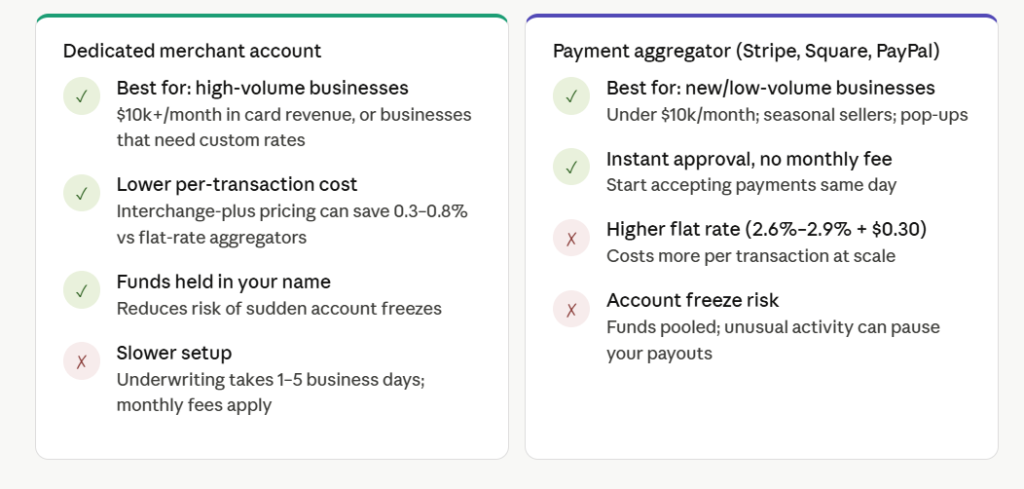
Your business gets a sub-merchant ID rather than its own MID. This means faster onboarding (sometimes instant), no monthly fees, but higher flat rates and a greater risk of account holds if the aggregator flags your activity as unusual.
Best for: startups, seasonal sellers, solopreneurs, and businesses under $10,000/month in card revenue.
| Factor | Dedicated Account | Payment Aggregator |
| Approval time | 1–5 business days | Minutes to hours |
| Monthly fee | $0–$50+ (varies) | Usually $0 |
| Rate at low volume | Can be higher all-in | Competitive (2.6%–2.9%) |
| Rate at high volume | Lower with negotiation | Fixed — hard to negotiate |
| Account freeze risk | Lower | Higher |
| Your own MID | Yes | No |
| Best entry point | $10,000+/month | Under $10,000/month |
| Contract term | Month-to-month or 1–3 yrs | No contract |
High-risk merchant accounts
Some industries are classified as ‘high-risk’ by acquirers due to elevated chargeback rates, regulatory complexity, reputational risk, or high average transaction values. These businesses cannot open standard merchant accounts and must work with high-risk specialist processors.
High-risk industries typically include: online gaming and gambling, adult content, travel and vacation packages, nutraceuticals and supplements, debt collection, cryptocurrency exchanges, firearms and ammunition, CBD and hemp products, subscription billing businesses, and international merchants in certain jurisdictions.
High-risk accounts typically come with higher processing rates (often 3%–6%), rolling reserves (5%–10% of volume held for 90–180 days), and stricter chargeback monitoring.
| Satellite article: ‘High-risk merchant accounts: complete guide for 2025’ — links back to this pillar page. |
Section 4: Merchant Account Fees — Complete Decoder
Every fee you might see — explained
| Fee type | What it is | Typical range | Negotiable? |
| Interchange | Set by card networks; paid to issuing bank. The largest component of your processing cost. | 1.15%–3.25% (varies by card type) | No |
| Assessment fee | Card network’s own fee (Visa, Mastercard, etc.) | 0.13%–0.15% | No |
| Processor markup | Your acquirer’s profit on top of interchange | 0.1%–1.0% + per-txn fee | Yes |
| Monthly account fee | Cost of maintaining the merchant account | $0–$99/month | Sometimes |
| PCI compliance fee | Charged by processor for managing your PCI status | $60–$240/year | Sometimes |
| Non-compliance fee | Penalty for failing PCI compliance | $10–$50/month | Avoid entirely |
| Chargeback fee | Per-chargeback admin fee charged by acquirer | $15–$50 per chargeback | Rarely |
| Statement fee | Monthly paper/PDF statement fee | $5–$15/month | Yes — ask to waive |
| Batch fee | Per daily batch settlement | $0.10–$0.30/day | Sometimes |
| Gateway fee | If using a third-party payment gateway | $10–$25/month + $0.05–$0.10/txn | Sometimes |
| Early termination fee | Penalty for leaving contract early | $250–$500 or remaining months | Negotiate out upfront |
| Retrieval fee | Fee when issuer requests transaction records for a dispute | $5–$15 per retrieval | No |
| AVS fee | Address Verification System check (card-not-present) | $0.05–$0.10 per check | No |
| Rolling reserve | Percentage of revenue withheld as security buffer | 5%–10% of volume, held 90–180 days | Negotiable for low-risk |
How to calculate your true effective rate
Your effective rate is the percentage of total card revenue that goes to processing fees. It is the single most useful number for comparing processors.
| Effective Rate = (Total Processing Fees for the Month ÷ Total Card Revenue for the Month) × 100Example: You paid $312 in fees on $12,000 in card revenue → Effective rate = 2.6% |
Always calculate your effective rate against your actual statements, not the headline rate in the marketing brochure. Include all fees: monthly account fee, gateway fees, PCI fees, and per-transaction charges. Many businesses are shocked to discover their stated 1.8% rate works out to a 2.7% effective rate once all fees are counted.
Interchange rates: why they vary
Interchange rates are set by Visa and Mastercard (published publicly) and vary based on:
- Card type: consumer debit (lower) vs premium rewards credit (higher) vs corporate cards (highest)
- Transaction method: card-present in-store (lower risk = lower rate) vs card-not-present online (higher risk = higher rate)
- Industry: some sectors get special reduced rates (e.g., utilities, government, healthcare, nonprofits)
- Transaction size: some high-value categories have capped or reduced interchange
- Data quality: sending full transaction data (level 2 or level 3 data) for B2B payments can dramatically reduce interchange
Section 5: Pricing Models — Which is Right for You?
The four main pricing models
1. Flat-rate pricing
One fixed percentage plus a flat per-transaction fee, regardless of card type. Example: 2.9% + $0.30 per online transaction.
Pros: simple to understand, predictable costs, easy to budget. Cons: you pay the same whether the customer uses a basic debit card (which has low interchange) or a premium platinum rewards card (which has high interchange). The processor profits from the spread.
Best for: businesses under $10,000/month, or those who value simplicity over cost optimisation.
2. Interchange-plus pricing (also called pass-through pricing)
You pay the actual interchange cost (passed through at cost) plus a fixed markup — e.g., interchange + 0.3% + $0.10. This is the most transparent pricing model because you can verify every charge against published interchange tables.
At higher volumes, this model almost always beats flat-rate. A business processing $50,000/month in mixed card types could save $300–$500/month versus a flat 2.9% rate.
Best for: businesses over $10,000–$15,000/month, or any business that wants full pricing transparency.
3. Tiered pricing (qualified/mid-qualified/non-qualified)
Transactions are sorted into tiers based on how the card was presented and what type of card was used. Qualified (best rate) covers basic debit and credit cards swiped in-person. Mid-qualified applies to keyed-in transactions. Non-qualified applies to rewards cards, corporate cards, and anything that doesn’t meet the processor’s ‘qualified’ criteria.
The problem: processors decide which tier your transactions fall into, and most card transactions end up in mid or non-qualified buckets. Effective rates are often much higher than the advertised qualified rate. This model benefits the processor, not the merchant.
Best for: nobody. Avoid this model if at all possible. Always push for interchange-plus instead.
4. Subscription/membership pricing
Pay a flat monthly membership fee and then a very small per-transaction fee (sometimes as low as $0.05–$0.15), with interchange passed through at cost. Providers include Stax and Payment Depot.
At high volumes, this can be the cheapest model overall. At low volumes, the monthly fee makes it uneconomical.
Best for: businesses processing over $30,000–$50,000/month with many transactions.
| Satellite article: ‘Interchange-plus vs flat-rate pricing: which saves your business more money?’ — links back to this pillar page. |
| Monthly volume | Best pricing model | Why |
| Under $5,000/month | Flat-rate aggregator (Stripe, Square) | Low volume, monthly fees not worth it |
| $5,000–$15,000/month | Flat-rate or interchange-plus | Start comparing; IC+ may save $50–$150/month |
| $15,000–$50,000/month | Interchange-plus | Typical saving of $200–$600/month vs flat-rate |
| $50,000–$200,000+/month | IC-plus or subscription/membership | Subscription model pays off at high transaction count |
| $200,000+/month | Negotiated interchange-plus or custom | Negotiate directly with a major acquirer |
Section 6: How to Apply for a Merchant Account
Documents you’ll need
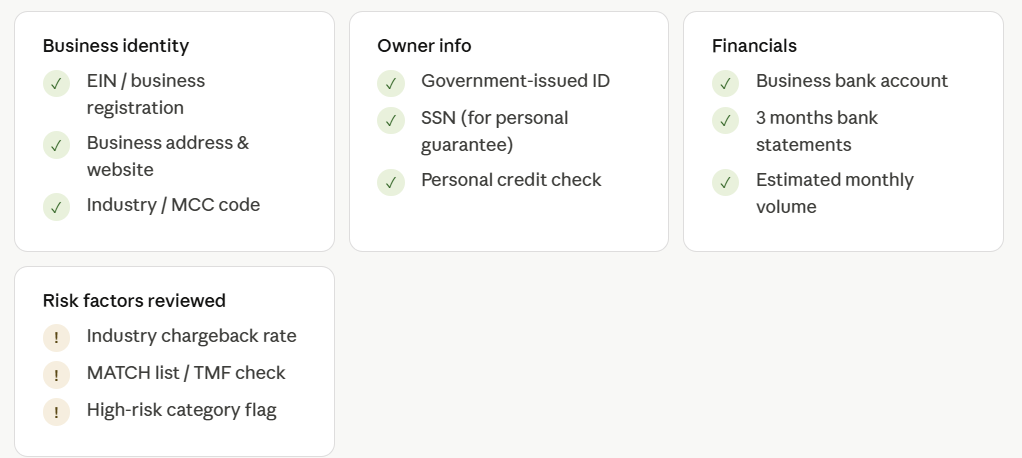
Having these ready before you apply will significantly speed up the underwriting process:
- Government-issued photo ID of all owners with 20%+ equity
- Business registration documents (certificate of incorporation, articles of organisation, DBA filing)
- EIN (Employer Identification Number) confirmation letter from HMRC/IRS/equivalent
- Business bank account details (voided cheque or bank letter)
- 3 months of business bank statements
- 3 months of previous processing statements (if switching processors)
- Business website URL (must be live with return/refund policy, contact details, and pricing clearly displayed)
- Estimated monthly processing volume and average transaction value
- Product/service description and fulfilment model
The underwriting process
Underwriting is the risk assessment your acquirer performs before granting you a merchant account. They are essentially deciding whether to extend you credit (since they advance funds before chargebacks resolve).
Key things underwriters assess:
- Industry and product/service type — is this a higher-risk category?
- Personal credit of the business owner (usually a soft pull)
- Business age and financial stability
- Estimated monthly volume and average ticket size — large volumes or high average transactions increase risk
- MATCH list / Terminated Merchant File (TMF) — a blacklist of merchants whose accounts were previously terminated for violations. Being on this list will result in immediate decline from most processors
- Online presence and reputation — reviews, BBB rating, social media presence
- Chargeback history with previous processors
Approval timeline
| Provider type | Typical approval time | What can slow it down |
| Payment aggregator (Stripe, Square) | Minutes to same day | Manual review triggered by certain industries or high volumes |
| Mid-market processor (Helcim, Dharma) | 1–2 business days | Incomplete documents, higher-risk industry |
| Bank-affiliated acquirer (Chase, Wells Fargo) | 3–5 business days | Full underwriting; industry complexity |
| High-risk specialist processor | 5–10 business days | More due diligence, may require attorney opinion letters |
Tips to improve your approval odds
- Apply with all documents ready — incomplete applications cause delays and sometimes declines
- Have a professional, live website with clear terms, refund policy, and contact page
- Start with realistic volume estimates — overstating volume raises risk flags
- If you have a chargeback history, proactively explain what you’ve changed
- Consider a smaller, specialist processor first if you are in a borderline industry
- Maintain a personal credit score above 600 — most acquirers run a soft check
| Satellite article: ‘Merchant account application checklist: everything you need to get approved’ — links back to this pillar page. |
Section 7: High-Risk Merchant Accounts
What makes a business ‘high-risk’?
Acquirers classify businesses as high-risk based on statistical chargeback rates in the industry, regulatory and legal complexity, reputational risk, business model characteristics (like subscription billing or delayed delivery), and geographic factors.
Being classified as high-risk does not mean your business is doing anything wrong — it simply means the acquiring bank perceives more financial or reputational exposure when processing your payments.
Common high-risk industries
| Industry | Why high-risk | Typical rate premium |
| Online gambling / gaming | High chargebacks, legal complexity by jurisdiction | +1%–3% |
| Travel agencies | Large tickets, long delay between purchase and service | +0.5%–2% |
| Adult content platforms | Reputational risk, age verification requirements | +1%–3% |
| Nutraceuticals / supplements | Marketing claims disputes, subscription billing | +0.5%–2% |
| Cryptocurrency exchanges | Regulatory uncertainty, fraud risk | +1%–4% |
| CBD / hemp products | Evolving legal status, high dispute rates | +0.5%–2% |
| Subscription box services | Recurring billing disputes, cancellation chargebacks | +0.5%–1.5% |
| Firearms / ammunition | Reputational risk, regulatory compliance | +0.5%–2% |
| Tech support services | History of fraud in the sector | +1%–3% |
| Multi-level marketing | Regulatory scrutiny, high refund rates | +0.5%–2% |
Rolling reserves: what they are and how to reduce them
A rolling reserve is a percentage of your processing volume that the acquirer holds back as security against potential chargebacks and fraud losses. Typically 5%–10% of volume is held for a rolling 90–180 day period.
Example: A 10% rolling reserve on a $50,000/month business means the processor holds $5,000 each month for 180 days. You will always have approximately $30,000 of your money in reserve at any given time.
How to reduce your reserve over time: maintain a chargeback rate below 1% for 6–12 consecutive months, submit financial statements showing healthy cash flow, proactively communicate volume changes, and renegotiate terms at your annual review.
Section 8: Chargebacks — Prevention, Disputes & Thresholds
What is a chargeback?
A chargeback is a forced reversal of a card transaction initiated by the cardholder’s bank. Unlike a refund (which you initiate), a chargeback is initiated by the customer disputing the charge with their bank. The funds are immediately pulled from your merchant account, and you are charged a chargeback fee ($15–$50) regardless of the outcome.
Why chargebacks happen
- Fraud: genuine stolen card or account takeover (called ‘true fraud’)
- Friendly fraud: customer receives goods but claims they did not (the most common and most frustrating type)
- Item not received: customer claims delivery never arrived
- Item not as described: significant difference between what was sold and what was received
- Subscription billing disputes: customer forgot they signed up or couldn’t cancel easily
- Duplicate charge: technical error causing double billing
- Credit not processed: you issued a refund but the customer didn’t see it in time
Chargeback ratio thresholds — know your limits
Card networks set maximum chargeback ratio thresholds. Exceeding them results in your business entering a monitoring programme, which leads to additional monthly fines ($5,000–$50,000+) and eventual account termination if not resolved.
| Programme | Threshold triggers at | Consequence if not resolved |
| Visa Dispute Monitoring Programme (VDMP) | Above 0.65% ratio OR 75 disputes/month | Monthly fines, increased acquirer scrutiny |
| Visa Fraud Monitoring Programme (VFMP) | Above 0.65% fraud-to-sales ratio | Fines; if above 0.9% for 9 months = account termination |
| Mastercard Excessive Chargeback Programme (ECP) | Above 1.0% ratio for 2+ months | Fines of $1,000–$5,000/month escalating |
| Mastercard High Excessive Chargeback Programme (HECP) | Above 1.5% ratio | Fines up to $50,000/month + disqualification risk |
Chargeback prevention strategies
- Use clear billing descriptors — the name on the bank statement should match your brand name exactly
- Implement 3D Secure (Visa Secure / Mastercard Identity Check) for online transactions
- Send delivery confirmation emails with tracking numbers
- Make your cancellation and refund process extremely easy to find and use — a customer who can’t find the cancel button calls their bank instead
- Use fraud screening tools (CVV, AVS, velocity checks, device fingerprinting)
- For subscription businesses, send reminder emails 5–7 days before billing
- Respond to retrieval requests within the deadline (typically 10–15 days)
- Keep records of all orders, delivery confirmations, and communications — you’ll need them to win disputes
Winning chargeback disputes
When you receive a chargeback notification, you have a limited window (typically 10–30 days depending on reason code) to submit a rebuttal — called ‘representment’. To win, you need compelling evidence:
- Signed order confirmation or terms and conditions acceptance
- Proof of delivery (carrier tracking with delivery signature)
- Screenshots of customer communication showing they received the product/service
- IP address, device fingerprint, and geolocation data showing the customer made the purchase
- Prior refund offers that were declined
Win rates for disputed chargebacks vary by reason code and evidence quality. Merchants with strong documentation win approximately 40%–60% of representments.
| Satellite article: ‘How to fight chargebacks and win: a step-by-step guide for merchants’ — links back to this pillar page. |
Section 9: PCI DSS Compliance
What is PCI DSS?
PCI DSS (Payment Card Industry Data Security Standard) is a set of security standards created by the card networks (Visa, Mastercard, Amex, Discover, JCB) to protect cardholder data. Any business that stores, processes, or transmits card data must comply.
Non-compliance can result in monthly fines from your processor ($10–$50/month), increased liability in the event of a data breach, and in severe cases, loss of card acceptance privileges.
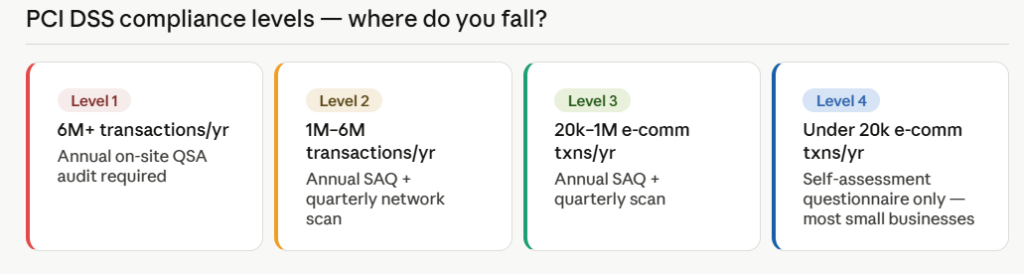
PCI DSS compliance levels
| Level | Who qualifies | Requirements |
| Level 1 | Over 6 million card transactions/year | Annual on-site audit by a Qualified Security Assessor (QSA); quarterly network scans by Approved Scanning Vendor (ASV) |
| Level 2 | 1 million–6 million transactions/year | Annual Self-Assessment Questionnaire (SAQ); quarterly ASV network scans |
| Level 3 | 20,000–1 million e-commerce transactions/year | Annual SAQ; quarterly ASV network scans |
| Level 4 | Under 20,000 e-commerce transactions/year (most small businesses) | Annual SAQ; quarterly scans recommended |
The cheapest way for small businesses to achieve PCI compliance
The single most cost-effective strategy for small businesses is to avoid ever touching card data in the first place. Use a hosted payment page or payment gateway that is itself PCI Level 1 certified. When the card data never enters your systems, your compliance scope shrinks dramatically to SAQ A — the simplest questionnaire (around 20 questions).
- Use hosted payment fields (Stripe Elements, Braintree Drop-in, Square Web Payments SDK)
- Never store raw card numbers — use tokens provided by your gateway
- Ensure your website uses HTTPS with a valid TLS certificate
- Limit access to payment systems to only staff who need it
- Complete your annual SAQ questionnaire honestly — it takes about 30–60 minutes for a small business
| Satellite article: ‘PCI DSS compliance checklist for small businesses: do it yourself in 2025’ — links back to this pillar page. |
Section 10: Best Merchant Account Providers Compared (2025)
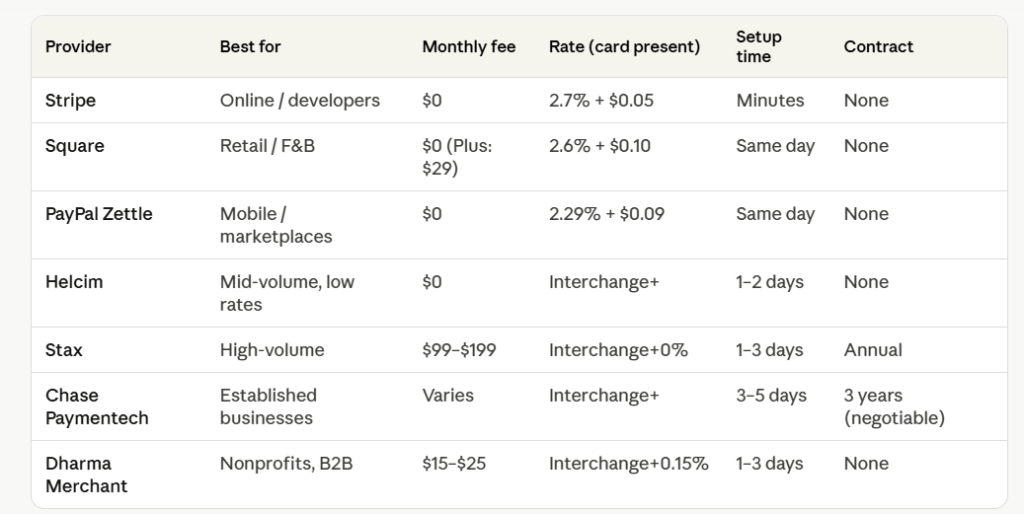
The following comparison covers the leading merchant account providers and payment aggregators available to small businesses. Note that Stripe, Square, and PayPal are technically payment aggregators, not dedicated merchant account providers, but are included because they serve the same function for most small businesses.
| Provider | Best for | Card-present rate | Card-not-present rate | Monthly fee | Contract | Notable strength |
| Stripe | Online, developers, SaaS | 2.7% + $0.05 | 2.9% + $0.30 | $0 | None | Best API; 135+ currencies; full payment stack |
| Square | Retail, restaurants, F&B | 2.6% + $0.10 | 2.9% + $0.30 | $0 (Plus: $29) | None | Free POS hardware; inventory; appointments |
| PayPal/Zettle | Mobile, marketplaces, international | 2.29% + $0.09 | 3.49% + $0.49 | $0 | None | Global reach; PayPal buyer protection |
| Helcim | Mid-volume, transparent pricing | Interchange+0.15%+$0.06 | Interchange+0.25%+$0.15 | $0 | None | IC-plus at no monthly fee; volume discounts auto-applied |
| Stax | High-volume businesses | Interchange+0%+$0.08 | Interchange+0%+$0.15 | $99–$199 | Annual | Zero % markup on interchange at high volume |
| Dharma Merchant | Nonprofits, B2B, high-data txns | Interchange+0.15%+$0.07 | Interchange+0.20%+$0.10 | $15–$25 | None | Excellent for level 2/3 data; nonprofit discounts |
| Chase Paymentech | Established SMBs wanting bank stability | Interchange-plus (negotiable) | Interchange-plus | Varies | Negotiable | Deep integration with Chase banking; large acquirer stability |
| Payment Depot (Stax) | Very high volume | Interchange+0% | Interchange+0% | $79–$199 | None | Membership model; zero markup for high-volume |
| Payline Data | Healthcare, B2B, nonprofits | Interchange+0.2%+$0.10 | Interchange+0.35%+$0.10 | $10–$20 | None | HIPAA-eligible; good for recurring billing |
| Fattmerchant (Stax) | Growth-stage businesses | Interchange-plus | Interchange-plus | $99+ | None | Analytics dashboard; omnichannel |
Rates shown are standard published rates as of 2025. Actual rates may vary and should be confirmed directly with each provider. Volume discounts may be available.
How to choose the right provider for your business
- Calculate your current effective rate (total fees ÷ total volume × 100)
- Estimate your next 12 months’ monthly volume — pick a provider optimized for that range
- Prioritize no early termination fees, especially for your first processor
- Ensure the gateway/POS integrates with your existing e-commerce platform or accounting software
- Read the full merchant agreement — look for rolling reserves, volume caps, and what triggers account review
- Check processor reviews on industry forums (Merchant Maverick, CPO Magazine, CardFellow) — customer service matters when disputes arise
| Satellite article: ‘Best payment processors for small businesses in 2025: ranked and reviewed’ — links back to this pillar page. |
Section 11: Merchant Account FAQs
Q1: Can I open a merchant account as a sole trader / freelancer?
Yes. Sole traders and freelancers can open merchant accounts, though some processors require a registered business name or DBA. Payment aggregators like Stripe and Square have the most flexible requirements for sole traders. A dedicated merchant account typically requires a business bank account.
Q2: What credit score do I need?
Most standard merchant account providers look for a personal credit score above 600. Payment aggregators typically do not run credit checks. High-risk processors may require scores above 650 and compensate for lower scores with higher rates or larger rolling reserves.
Q3: Can a merchant account be declined?
Yes. Common reasons for decline include being on the MATCH/TMF list, operating in a prohibited industry (adult, firearms, gambling — depending on the processor), having a poor credit history, a high-risk business model without sufficient supporting documentation, or a prior history of chargeback issues.
Q4: How long until I receive my funds?
Standard settlement is 1–3 business days after your daily batch close. Many processors now offer next-day or same-day settlement for an additional fee (typically 0.5%–1%). Payment aggregators like Stripe offer instant payouts for 1.5% fee.
Q5: Can I accept international cards?
Yes, most merchant accounts accept Visa and Mastercard from any country. Amex international cards may require a separate agreement. Be aware that cross-border interchange fees apply to cards issued in a different country from your acquiring bank, typically adding 0.4%–1.5% to processing costs.
Q6: What is a merchant ID (MID) and do I need to know mine?
Your Merchant ID (MID) is a unique identifier assigned to your business by your acquirer. You will need it when contacting processor support, reconciling disputes, and sometimes when integrating with third-party software. Payment aggregators give you a sub-merchant ID, which functions similarly.
Q7: Can I have multiple merchant accounts?
Yes, and for high-volume businesses or those with multiple business lines, this can be a smart strategy. Multiple accounts provide redundancy (one backup if the other is suspended), allow you to optimise rates for different sales channels, and can help manage chargeback ratios by segment.
Q8: What happens if my merchant account is terminated?
Termination for cause (excessive chargebacks, fraud, policy violation) typically results in your business being added to the MATCH/TMF list, which makes opening a new account with most processors very difficult for 5 years. That is why maintaining low chargeback rates and ethical practices is critically important.
Q9: Is a payment gateway the same as a merchant account?
No. A payment gateway is the technology that securely transmits card data between your website or POS and the acquiring bank. A merchant account is the banking relationship that holds the funds. You need both. Some processors bundle them together; others offer them separately.
Q10: What is a chargeback ratio and how is it calculated?
Chargeback ratio = number of chargebacks in a month ÷ number of transactions in the same month × 100. Visa and Mastercard calculate this differently in some cases (Visa uses transactions in the current month; Mastercard can use prior month transactions as the denominator). Keep your ratio below 0.5% to stay safely clear of monitoring thresholds.
Q11: Do I need a merchant account for contactless payments?
Yes. Accepting contactless (tap-to-pay), Apple Pay, Google Pay, or NFC payments still routes through the card networks and requires a merchant account. The payment method changes how the card data is captured, not the underlying processing infrastructure.
Q12: What is a payment facilitator (PayFac) model?
A PayFac (like Stripe or Square) is a company that holds its own master merchant account and underwrites sub-merchants (your business) under it. This allows instant onboarding but means you share a merchant account structure with thousands of other businesses, increasing the risk of holds during network-level fraud events.
Q13: How does merchant account fee negotiation work?
Negotiation works best once you are processing over $15,000–$20,000/month and have 3+ months of clean statements. Use competing quotes from at least three processors. The elements most negotiable are: processor markup, monthly account fee, PCI compliance fee, statement fee, and early termination fee. Interchange and assessment fees are non-negotiable as they are set by card networks.
Q14: What is a virtual terminal?
A virtual terminal is a web-based interface that allows you to manually key in card details for phone or mail orders (MOTO — mail order/telephone order) without a physical card reader. It is typically included with merchant accounts and gateways. Note: MOTO transactions carry higher interchange rates because they are card-not-present.
Q15: Can I use the same merchant account for online and in-store sales?
Yes, most modern processors offer omnichannel merchant accounts that cover both card-present (in-store POS) and card-not-present (online gateway) transactions under one account. Rates will differ between channels since in-person transactions carry lower interchange.
Conclusion
A merchant account is not just a technical banking arrangement — it is the foundation of your business’s ability to participate in the modern economy. Understanding how it works, what it costs, and how to choose the right provider is one of the highest-ROI pieces of knowledge a small business owner can have.
Whether you are starting out with a payment aggregator like Stripe or Square, growing into a dedicated interchange-plus account to save on fees, or navigating the complexities of a high-risk industry, the principles in this guide apply universally.
Use this page as your anchor reference. Explore the satellite articles for depth on each sub-topic. And return as your business evolves — the right merchant account solution at $5,000/month in revenue is rarely the right one at $100,000/month.
| Bookmark this page. Share it with your accountant or operations team. And revisit your merchant account costs annually — a 30-minute review can often save hundreds or thousands of dollars per year. |