



The digital economy runs on smooth, secure, and fast payment processing. Whether it’s an eCommerce brand, SaaS company, or online marketplace, every business needs the right setup to accept payments. This is where payment gateways and merchant accounts come in.
Many business owners confuse the two, but they serve different roles in processing online transactions. Understanding the difference between a payment gateway and a merchant account can help you build a reliable, cost-efficient payment system for your business.
Introduction: Why You Need to Understand Payment Gateways and Merchant Accounts
Imagine you’ve launched an online store and customers are ready to buy. But without the proper payment setup, you won’t be able to accept credit card payments. This is where learning what a payment gateway is and how it works for online businesses becomes crucial. The gateway acts as the bridge between your website, your customer’s card, and your merchant account, which holds the funds temporarily before they reach your business bank account.
To stay competitive, especially for small business owners, understanding how a payment gateway connects with a merchant account ensures smoother transactions, fewer errors, and improved customer trust.
What Is a Payment Gateway?
A payment gateway is a secure online technology that allows businesses to accept credit and debit card payments. It encrypts sensitive customer information, ensuring the safe transfer of payment data between the customer, the merchant, and the payment processor.
Think of it as the digital equivalent of the credit card terminal you see in physical stores. The difference is that everything happens online, automatically, and almost instantly. Gateways like Stripe, PayPal, and Authorize.net play a crucial role in securely validating each transaction.
How Does a Payment Gateway Work for Online Businesses?
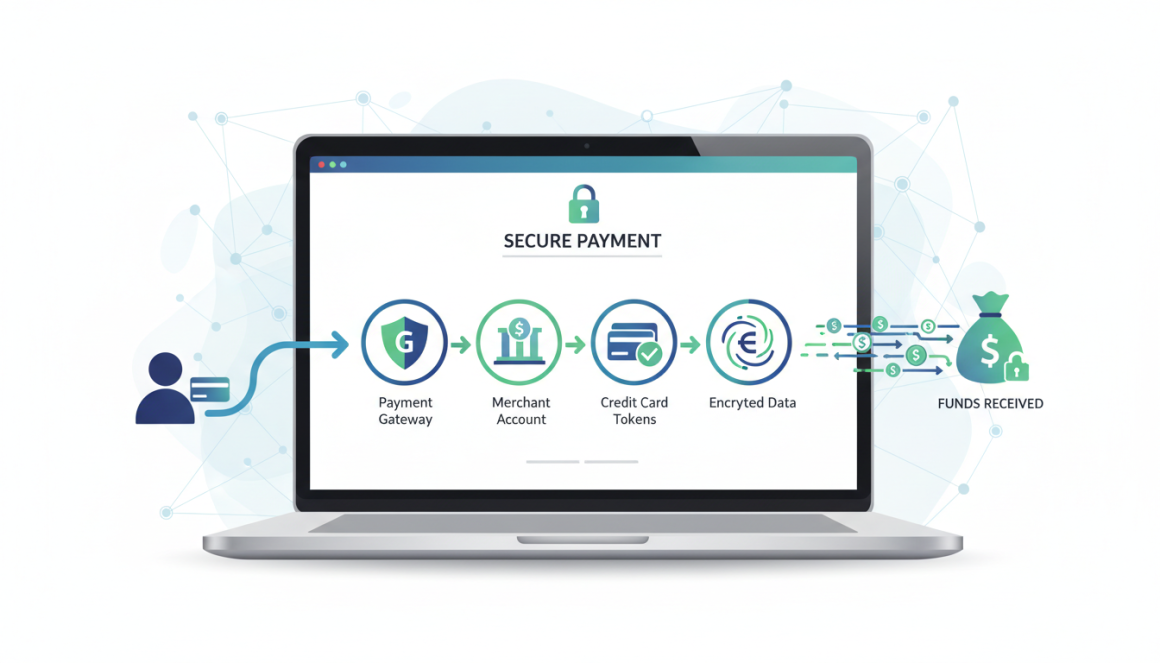
The process behind a gateway is simpler than it seems. Here’s a detailed explanation of how a payment gateway processes online credit card transactions:
| Step | Action | Details |
|---|---|---|
| 1 | Customer enters payment info | The buyer inputs credit/debit card details or chooses a digital wallet. |
| 2 | Gateway encrypts data | The gateway encrypts the transaction data for security. |
| 3 | Transaction sent to processor | The gateway sends the encrypted data to the payment processor. |
| 4 | Authorization request | The issuing bank checks for available funds and fraud risk. |
| 5 | Approval or denial | The gateway returns an approval message or declines the payment instantly. |
| 6 | Settlement | The funds move to the merchant account before going to your business bank. |
This entire process happens in seconds, creating a seamless payment experience for both customers and businesses.
What Is a Merchant Account?
A merchant account is a type of bank account that temporarily holds funds from credit card sales before transferring them to your business bank account. It’s a system that ensures money from approved transactions is processed, verified, and settled correctly.
Merchant accounts are provided by merchant service providers such as Chase Payment Solutions, Worldpay, or Elavon. These providers handle the behind-the-scenes settlement of funds between banks and ensure compliance with payment networks like Visa and Mastercard.
Without a merchant account, you can’t legally or logistically process credit card transactions. That’s why payment gateways and merchant accounts work together — one authorizes transactions, the other holds the funds.
The Role of a Merchant Account in Payment Processing
The role of a merchant account is to act as the middle layer between your customer’s bank and your business account. Once the payment is approved, the funds are temporarily held in the merchant account. After verification, they get transferred to your main business account, typically within one to three days.
This level of verification helps prevent chargebacks, fraud, and data errors, ensuring safer transactions for both merchant and customer.
Payment Gateway vs. Merchant Account for Small Business Owners
At a glance, both these terms may sound similar, but they do very different jobs. Here’s a quick comparison of payment gateways and merchant accounts for eCommerce.
| Feature | Payment Gateway | Merchant Account |
|---|---|---|
| Function | Authorizes and encrypts card payments online | Holds funds until settlement |
| Primary Use | Online transaction security and authorization | Money transfer and settlement |
| Provider Examples | Stripe, PayPal, Authorize.net | Worldpay, Chase, Elavon |
| Needed For | Online businesses | Any business that accepts card payments |
| Security Role | Protects customer data | Ensures financial compliance |
The difference between a payment gateway and a merchant account explained in simple terms:
- The gateway checks and approves the transaction.
- The merchant account stores the funds until they’re safely transferred to the business bank account.
How a Payment Gateway Connects with a Merchant Account
A gateway sends the transaction details to the processor, which then communicates with the acquiring bank (the holder of the merchant account). If approved, the funds move into your merchant account before being sent to your business account.
This relationship forms the foundation of modern online payment processing, where each component depends on the other. Businesses that understand how a payment gateway connects with a merchant account can identify where issues may occur — for instance, delays in settlement or authorization failures.
All-In-One Processors vs. Separate Merchant Accounts
Stripe, PayPal, and Square
Some providers like Stripe, PayPal, and Square offer an all-in-one payment processor. This means they combine both the gateway and merchant account into one service.
These integrated systems are easier to set up, especially for small business owners or startups. However, they often come with higher transaction fees and less flexibility when scaling.
Traditional Merchant Service Providers
On the other hand, businesses with larger volumes might prefer a separate merchant account setup using providers like Elavon, Chase Payment Solutions, or Worldpay. This approach offers more control over transaction terms, interchange rates, and customer service.
Which Is Better: Payment Gateway or Merchant Account?
The better option depends on your business type and transaction volume. For startups and freelancers, an all-in-one service like Stripe or PayPal may be more convenient. But for medium to large eCommerce companies, a direct merchant account setup can save money on fees and offer more control.
In short, payment gateways focus on transaction authorization, while merchant accounts manage fund movement and settlement. Both are essential if you want to process payments efficiently and safely.
Advantages of Using a Payment Gateway Over a Merchant Account
A payment gateway simplifies integration with your website, supports multiple payment methods, and delivers faster digital authorization. While a merchant account focuses on backend fund management, a gateway is all about enabling a secure, user-friendly front-end experience.
Gateways like Authorize.net or PayPal also provide fraud detection tools, recurring billing support, and data analytics — giving businesses a competitive advantage in managing and understanding their payment flows.
Pros and Cons of Payment Gateway vs. Direct Merchant Account Setup
| Aspect | Payment Gateway (All-in-One) | Separate Merchant Account + Gateway |
|---|---|---|
| Setup Ease | Quick and beginner-friendly | Longer approval process |
| Costs | Higher fees per transaction | Lower long-term costs |
| Scalability | Great for startups | Better for growing companies |
| Support | Streamlined for basic users | More customization and control |
| Risk Management | Limited policy flexibility | Greater fraud monitoring |
Both models are valid, but understanding your business needs helps determine which configuration is most efficient.
Why Businesses Need Both a Payment Gateway and a Merchant Account
Every online business requires both components for end-to-end transaction processing. The gateway ensures transaction approval and customer security, while the merchant account handles money settlement. Removing either one breaks the chain, leading to failed or insecure transactions.
Having both ensures your eCommerce operation can handle payments reliably — improving customer trust, cash flow, and compliance.
Conclusion
Understanding what a payment gateway is and how it differs from a merchant account can help you make informed decisions about your online payment setup. Both are vital components of digital commerce.
For small business owners, choosing between an all-in-one processor and a separate merchant account depends on budget, transaction volume, and scalability goals. With secure gateways and reliable merchant services, businesses can ensure every customer transaction is smooth, compliant, and safe.
For further technical details, explore resources like NerdWallet for merchant service reviews and Investopedia for in-depth financial explanations.
FAQs
1. What is the main difference between a payment gateway and a merchant account?
A payment gateway authorizes and encrypts online transactions. A merchant account temporarily holds funds before transferring them to your business account.2. Can I use a payment gateway without a merchant account?
You can if you use an all-in-one service like PayPal or Stripe, as they integrate both. Otherwise, you need both systems for full functionality.
3. Which is better for small businesses: a payment gateway or a merchant account?
Most small businesses prefer all-in-one solutions like Stripe due to easier setup. Larger enterprises often choose separate merchant accounts for lower long-term fees.