



Every month, a payment processing statement lands in your inbox. Most business owners glance at the total and move on. That is one of the most expensive habits in small business finance. Hidden inside those pages are fees, surcharges, and inflated markups that quietly drain thousands of dollars from your bottom line each year — and most of them are negotiable or entirely avoidable.
Payment processing is now one of the top three operating expenses for retail and e-commerce businesses, yet it remains one of the least scrutinized. A comprehensive cost review of your merchant account statement can reveal savings of anywhere from 15% to 40% on your total processing costs. This guide walks you through exactly how to do that — line by line, category by category.
| Key takeaway: Businesses that conduct a structured annual review of their payment processing statement reduce total processing costs by an average of 23%, according to merchant cost analysis data from MerchantServicesInfo.xyz. |
1. Understanding your payment processing statement
Before you can identify savings opportunities, you need to understand what you are looking at. A standard payment processing statement is divided into several sections, and each section hides its own set of potential overcharges.
Bar chart showing average savings potential by fee category when reviewing a payment processing statement
Average savings potential by fee category
Percentage of businesses that successfully reduced costs in each area
Based on merchant cost review data across 500+ businesses. Source: merchantservicesinfo.xyz
What every statement includes
Your statement will typically show your total transaction volume, the number of transactions processed, a breakdown of card types accepted (Visa, Mastercard, Amex, debit), and a long list of fee categories. The challenge is that processors deliberately make these statements complex. Multiple fees are often described with vague or technical language designed to make comparison difficult.
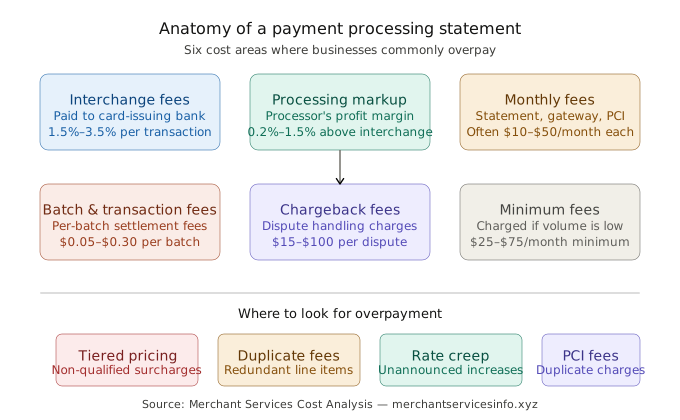
Table 1: Common fee categories on a payment processing statement
| Fee Category | What It Is | Typical Range | Negotiable? |
| Interchange fees | Paid to card-issuing bank | 1.5%–3.5% per transaction | No (set by networks) |
| Processing markup | Processor’s profit margin | 0.2%–1.5% + per-txn fee | Yes |
| Monthly statement fee | Cost of receiving statement | $5–$25/month | Yes |
| PCI compliance fee | Security compliance charge | $10–$40/month | Yes |
| Batch/settlement fee | Daily batch processing | $0.05–$0.30/batch | Yes |
| Chargeback fee | Dispute handling | $15–$100/dispute | Partially |
| Monthly minimum fee | Applied if volume is too low | $25–$75/month | Yes |
| Gateway fee | Payment gateway access | $10–$30/month | Yes |
2. The three pricing models — and why they matter
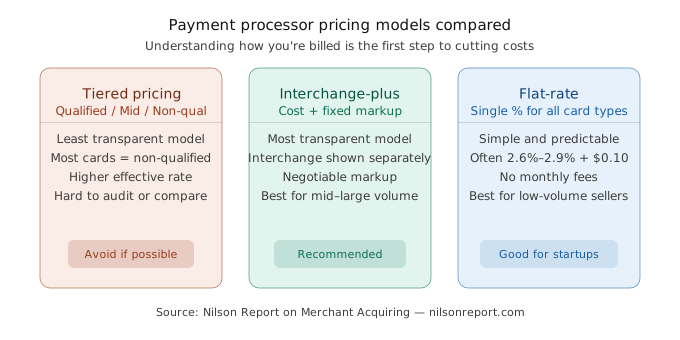
One of the most important things to identify on your statement is which pricing model your processor uses. The model determines how much visibility you have into actual costs, and which model you are on has a direct impact on how much you pay.
Tiered pricing
Tiered pricing groups all transactions into three buckets: qualified, mid-qualified, and non-qualified. Processors define these categories themselves, which gives them enormous flexibility to classify most of your transactions in the highest-cost tier. If your statement shows rates like 1.69%, 2.19%, and 2.99% with no interchange detail, you are on a tiered plan. This is the least transparent and most expensive model for the majority of businesses.
Interchange-plus pricing
Interchange-plus (also called cost-plus) pricing shows you the actual interchange cost charged by Visa or Mastercard, plus a fixed markup from your processor. For example, a statement might show interchange of 1.80% + 0.20% processor markup + $0.10 per transaction. This model is the most transparent and typically the most cost-effective for businesses processing more than $10,000 per month.
Flat-rate pricing
Flat-rate processors like Square or Stripe charge a single percentage on all transactions, such as 2.6% + $0.10 per swipe. There are no monthly fees and no complex categories. This model works well for very small or seasonal businesses, but it becomes expensive as volume grows because you lose any benefit from lower-cost card types like basic debit cards.
Table 2: Pricing model comparison at a glance
| Model | Transparency | Best For | Hidden Risk |
| Tiered | Low | Processor (not you) | Non-qual surcharges |
| Interchange-plus | High | Mid-to-large businesses | Markup creep |
| Flat-rate | Medium | Startups, low volume | Costly at scale |
3. Five fees to challenge immediately
Once you understand your pricing model, the next step is to scan for specific fees that are commonly inflated, duplicated, or entirely unjustified. Here are the five categories where businesses most frequently find unnecessary charges.
PCI compliance fees
Payment Card Industry (PCI) compliance is a security requirement, not an optional service. However, many processors charge a separate PCI compliance fee of $10–$40 per month on top of whatever security infrastructure they already provide. If you have already completed your PCI self-assessment questionnaire (SAQ) independently, you may be paying this fee without receiving any corresponding service. Always ask your processor to itemize exactly what this fee covers.
Statement and service fees
Monthly statement fees, online account access fees, and customer service fees are among the most purely discretionary charges on your statement. They exist because processors can charge them, not because they reflect any real cost. These fees are almost always negotiable, and many processors will waive them entirely if you ask — particularly if you process a meaningful volume of transactions.
Non-qualified transaction surcharges
If you are on a tiered pricing plan, pay close attention to which of your transactions are being categorized as mid-qualified or non-qualified. Processors control these classifications, and a card that should qualify at the base rate is often deliberately placed in a higher tier. Ask your processor to provide the specific criteria they use to classify card types into each tier, and compare those criteria against your actual transaction mix.
Batch settlement fees
Every time you settle your daily transactions, your processor may charge a batch fee of $0.05 to $0.30. If you batch multiple times per day — for example, once per location or once per shift — these fees multiply quickly. Consolidating to a single daily batch can cut these costs significantly without any impact on your cash flow timing.
Early termination fees
While not a recurring monthly cost, early termination fees (ETFs) deserve attention during your statement review because they affect your ability to switch processors. ETFs can range from $200 to $600 or more. Understanding what your contract says about termination gives you leverage in rate negotiations. Many processors will waive ETFs for long-standing customers who are considering switching.
| Industry benchmark: The average US business overpays by $1,200–$3,500 per year on payment processing fees. A single structured review can recover that in renegotiated rates alone. (Source: MerchantServicesInfo.xyz) |
4. How to calculate your effective rate
The single most powerful number in your payment processing review is your effective rate. This is the true total cost of accepting card payments, expressed as a percentage of your total sales volume. Calculating it takes less than two minutes and immediately reveals whether you are being overcharged.
Formula: Total processing fees ÷ Total card sales volume × 100 = Effective rate (%)
For example, if you paid $1,200 in total fees on $40,000 in card sales, your effective rate is 3.0%. The industry benchmark for a business primarily accepting consumer Visa and Mastercard credit cards is between 1.7% and 2.3%. If your effective rate is above 2.5%, you are almost certainly paying more than you should be.
Table 3: Effective rate benchmarks by business type
| Business Type | Avg. Effective Rate | High-Cost Signal | Target Rate |
| Retail (card-present) | 1.7%–2.0% | Above 2.4% | Below 1.9% |
| Restaurant | 1.8%–2.1% | Above 2.5% | Below 2.0% |
| E-commerce | 2.0%–2.5% | Above 3.0% | Below 2.3% |
| B2B / Invoicing | 2.2%–2.8% | Above 3.2% | Below 2.6% |
| Healthcare | 1.9%–2.3% | Above 2.8% | Below 2.2% |
5. Negotiating with your payment processor
Armed with your effective rate and a list of questionable fees, you are now in a strong position to negotiate. Payment processing is a competitive industry, and processors have far more flexibility on pricing than they typically reveal. Knowing how to have this conversation is the difference between keeping your current rate and achieving a meaningful reduction.
Gather competitive quotes first
Before you call your processor, obtain quotes from at least two competing processors. This is not about switching — it is about creating negotiating leverage. When you can show your current processor that a competitor is offering interchange-plus pricing at 0.15% + $0.08 per transaction versus your current blended rate of 2.6%, the conversation changes immediately. Most processors have a retention team specifically empowered to offer better rates to customers who are considering leaving.
Request an interchange-plus conversion
If you are currently on tiered pricing, your single most effective negotiating move is to request a conversion to interchange-plus pricing. This one change typically reduces processing costs by 15%–25% for businesses processing more than $15,000 per month. Processors may resist this because tiered pricing is more profitable for them, but most will agree to a conversion rather than lose your account.
Ask for fee waivers in writing
Any fees that are waived or reduced during your negotiation should be confirmed in writing — either through an amended merchant agreement or a written email confirmation from your account manager. Verbal agreements on fee changes are common in this industry, but they are frequently reversed at the next contract renewal or when your account manager changes.
6. Tools and resources to help you audit your statement
You do not need to conduct a payment processing review alone. Several tools and resources can help you benchmark your costs and identify savings opportunities more efficiently.
The Nilson Report (nilsonreport.com) publishes annual data on interchange rates, card network fee changes, and processor market share. It is the most authoritative source of payment industry benchmarking data and is widely used by CFOs and financial analysts to evaluate whether their merchant costs are in line with market rates.
The Electronic Transactions Association (electran.org) provides a free merchant resource library including sample merchant agreements, fee glossaries, and a directory of member processors. This is particularly useful when comparing the language in your current contract against industry-standard terms.
For a practical fee-by-fee analysis tool and processor comparison database, MerchantServicesInfo.xyz offers a free statement analysis framework that helps business owners calculate their effective rate, identify non-standard fees, and generate a savings report they can use in processor negotiations.
Conclusion
Your payment processing statement is not just a monthly bill — it is a roadmap to hidden savings. By understanding your pricing model, calculating your effective rate, identifying unjustified fees, and entering processor negotiations with competitive data in hand, most businesses can achieve measurable cost reductions within 30 to 60 days.
The most important action you can take today is to pull your last three months of statements, run the effective rate calculation, and compare your result against the benchmark for your business type. If the number is higher than it should be, you now have everything you need to change it.
Payment processing costs are not fixed. They are negotiated. And every dollar you recover goes directly to your bottom line.
Frequently asked questions
How often should I review my payment processing statement?
You should conduct a thorough review at least once per year, ideally before your merchant agreement renews. A lighter monthly check — comparing your effective rate month over month — takes less than five minutes and will alert you to any rate increases or new fees being added without notice. Many businesses discover mid-year rate increases only during an annual review, by which point they have already overpaid for six months.
Can I switch payment processors without losing my transaction history?
Yes. Transaction history is stored in your own merchant account and point-of-sale system records, not exclusively with your processor. Most modern POS and accounting integrations export full transaction history in CSV or Excel format. Before switching processors, export your transaction history from your current system and confirm that your new processor’s gateway is compatible with your existing POS hardware to avoid equipment replacement costs.
What is the difference between interchange and my processing rate?
Interchange is the base cost set by Visa and Mastercard and paid directly to the card-issuing bank. It is non-negotiable and the same regardless of which processor you use. Your processing rate is the additional markup that your processor charges on top of interchange. This markup is entirely negotiable. On a tiered plan, the interchange cost is bundled invisibly into your quoted rates. On an interchange-plus plan, the two are shown separately, which is why interchange-plus is the preferred model for cost transparency and negotiation.
Is it worth hiring a consultant to review my payment processing costs?
For businesses processing more than $50,000 per month in card payments, a merchant services consultant can often identify savings that far exceed their fee. Consultants typically charge either a flat project fee or a percentage of documented savings over a 12-month period. For smaller businesses, a self-directed review using the framework in this article — combined with free tools like the one at MerchantServicesInfo.xyz — will typically be sufficient to identify the most significant cost-saving opportunities without additional expense.
About this article
This article is intended for informational purposes and reflects general payment processing industry practices in the United States as of 2026. Individual merchant agreements and fee structures vary by processor and contract. Always review your specific merchant agreement before making changes to your payment processing arrangement.