




Every time you tap your credit card at a checkout counter, something happens behind the scenes that most people never think about. Money moves. Systems talk to each other. And somewhere in the middle of that split-second transaction, a small fee gets quietly collected. That fee has a name: the interchange fee. If you are a business owner, a payment professional, or simply someone who wants to understand why card acceptance costs money, this guide is for you.
Interchange fees are the backbone of the global card payment ecosystem. They influence the prices you pay at the register, the rewards you earn on your credit card, and the profit margins of every merchant who accepts plastic. Understanding how they work — and who actually benefits — can change the way you think about modern commerce.
What Is an Interchange Fee?
An interchange fee is a transaction fee paid by a merchant’s bank (the acquiring bank) to a cardholder’s bank (the issuing bank) every time a customer uses a debit or credit card to make a purchase. It is sometimes called a swipe fee, though that term has become a bit of a misnomer in the era of contactless payments.
The fee is not paid directly by the consumer. It is paid between financial institutions. However, merchants typically fold this cost into their overall pricing, which means consumers often feel its effects indirectly through higher retail prices. The interchange fee is typically expressed as a percentage of the transaction amount plus a flat fee — for example, 1.80% + $0.10.
These fees are set by card networks such as Visa and Mastercard, not by the banks themselves. The networks publish interchange schedules that banks and merchants must follow. These schedules are updated periodically — often twice a year — and can vary significantly depending on the type of card used, the type of merchant, and the method of payment.
The Four Parties Involved in Every Card Transaction

To understand interchange fees fully, you need to understand the four-party model that governs most card transactions. Each party plays a specific role, and the financial mechanism of interchange keeps them all working together.
The cardholder is the customer who uses the card to make a purchase. The merchant is the business that sells the goods or services and accepts the card payment. The acquiring bank (also called the merchant bank) is the financial institution that processes payments on behalf of the merchant. The issuing bank is the financial institution that issued the credit or debit card to the cardholder.
The card network — Visa, Mastercard, American Express, or Discover — sits at the center of this model, setting the rules, processing the transaction data, and determining the interchange rate that applies.
Figure 1: Key Parties in a Card Transaction
| Party | Role | Receives / Pays |
| Cardholder | Makes the purchase | Earns rewards (indirectly) |
| Merchant | Sells goods/services | Pays interchange (via MDR) |
| Acquiring Bank | Processes merchant transactions | Receives MDR, pays interchange |
| Issuing Bank | Issues card to cardholder | Receives interchange fee |
| Card Network (Visa/Mastercard) | Sets the rules & rates | Earns network/assessment fee |
Source: General industry model based on Visa/Mastercard interchange frameworks.
How Are Interchange Rates Determined?
Interchange rates are not random. They are calculated based on a complex set of factors that card networks have developed over decades. The type of card is the single biggest determinant. Rewards credit cards carry higher interchange rates because a portion of the fee funds the rewards program. Premium travel cards, for instance, often carry rates above 2.50%.
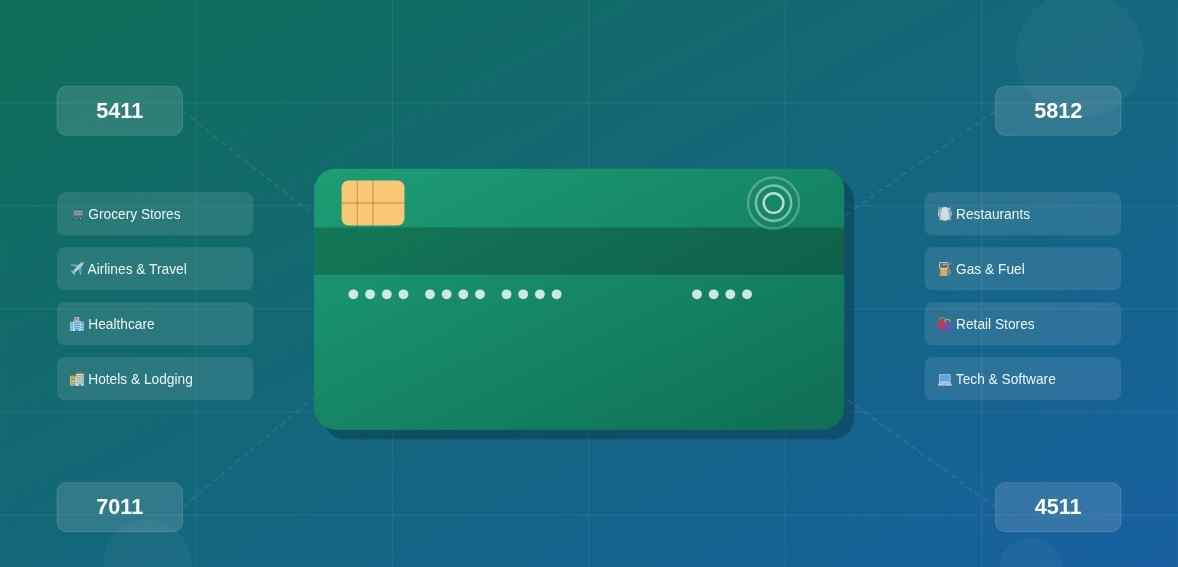
The merchant category code (MCC) also plays a major role. Merchants are assigned a four-digit code that identifies their industry. Supermarkets, healthcare providers, and charities often receive lower interchange rates because the networks consider them lower-risk categories. Luxury goods retailers and hotels often face higher rates.
The method of entry also matters. Card-present transactions — where the physical card is swiped, dipped, or tapped — typically carry lower interchange rates than card-not-present transactions, such as online purchases. This is because card-present transactions are considered lower fraud risks. The size of the transaction can also affect rates, with very small transactions sometimes subject to special pricing.
Table 1: Typical Interchange Rates by Card Type (United States)
| Card Type | Typical Interchange Rate | Who Benefits |
| Standard Debit Card | ~0.05% + $0.21 | Issuing bank |
| Standard Credit Card | 1.51% + $0.10 | Issuing bank |
| Rewards Credit Card | 1.65%–2.40% | Issuing bank + cardholder |
| Business Credit Card | 2.50%–3.50% | Issuing bank |
| Premium / Luxury Card | Up to 3.50%+ | Issuing bank + cardholder |
Note: Rates are approximate and vary by network, merchant category, and region. Data reflects general US market ranges as of 2024–2025.
Interchange Fees vs. Merchant Discount Rate (MDR)
These two terms are often confused, and for good reason — they are closely related. The merchant discount rate (MDR) is the total fee that a merchant pays to accept a card payment. It is made up of three components: the interchange fee, the card network’s assessment fee, and the acquiring bank’s markup or processing fee.
The interchange fee is by far the largest component, typically accounting for 70% to 90% of the total MDR. The assessment fee charged by Visa or Mastercard is much smaller, usually around 0.10% to 0.14% of the transaction. The acquiring bank’s markup varies widely depending on the payment processor and the pricing model chosen.
For small and medium-sized businesses, understanding the difference between interchange and MDR is critical for managing payment processing costs. Merchants who choose interchange-plus pricing can see a transparent breakdown of each component, which often leads to lower overall costs compared to flat-rate pricing models.
A Look at the Major Card Networks

Visa
Visa operates an open-loop network, meaning it does not issue cards directly to consumers. Instead, it partners with thousands of issuing banks worldwide. Visa publishes its interchange rate schedules publicly on its website, which makes it one of the more transparent players in the space. Its rates in the US for consumer credit cards typically range from about 1.15% to 2.40%, depending on the card type and merchant category. Visa updates its US interchange rates twice a year, in April and October.
Mastercard
Like Visa, Mastercard operates an open-loop model and publishes its interchange rates publicly. Mastercard’s rates are broadly similar to Visa’s, with US consumer credit card rates typically falling between 1.15% and 2.50%. Mastercard has been particularly active in introducing new pricing tiers for specific categories such as healthcare and utilities, acknowledging that different industries have different payment risk profiles.
American Express
American Express traditionally operated a closed-loop network, meaning it functioned as both the card issuer and the network. This allowed it to set higher interchange rates — historically among the highest in the industry — because it could justify them through its premium cardholder base and strong spending data. In recent years, American Express has expanded through its OptBlue program, which allows smaller merchants to accept Amex through third-party processors at rates more competitive with Visa and Mastercard.
Discover
Discover also operates a closed-loop network and is known for having slightly lower merchant fees than American Express. Discover’s interchange rates are generally competitive with Visa and Mastercard, and the network has been growing its merchant acceptance coverage significantly over the past decade. Discover cards are now accepted at virtually all US merchants that accept Visa or Mastercard.
Table 2: Card Network Comparison — Interchange Rate Models
| Network | Rate-Setting Model | Publishes Rates? | Avg. Credit Rate |
| Visa | Interchange++ / tiered | Yes (publicly) | ~1.50%–2.40% |
| Mastercard | Interchange++ / tiered | Yes (publicly) | ~1.55%–2.50% |
| American Express | Closed-loop / OptBlue | Partial | ~2.30%–3.50% |
| Discover | Closed-loop | Partial | ~1.56%–2.30% |
Note: Rates are indicative averages for US consumer credit cards. Actual rates vary by card product and merchant type.
Why Do Interchange Fees Exist?
Interchange fees serve a specific economic purpose. They compensate issuing banks for the risks and costs they absorb when extending credit to cardholders. When you use a credit card, your issuing bank fronts the money to the merchant immediately, even though it may not collect your payment for 30 days or more. During that time, it carries credit risk.
Interchange fees also help fund fraud prevention systems, dispute resolution processes, and the rewards programs that cardholders enjoy. Without interchange revenue, banks would need to charge cardholders higher annual fees to maintain these services. In essence, interchange fees represent a hidden subsidy: merchants and their customers collectively fund the rewards that credit card users receive.
This dynamic has been a source of controversy for decades. Critics argue that low-income consumers who pay with cash effectively subsidize wealthy cardholders who earn points and miles at checkout. This cross-subsidy argument has driven much of the regulatory debate around interchange fee reform globally.
The Global Debate: Regulation and Reform
Interchange fees have attracted significant regulatory scrutiny around the world. The European Union took landmark action in 2015, capping interchange fees for consumer credit cards at 0.30% and debit cards at 0.20% across all EU member states. The cap dramatically reduced merchant costs in Europe and forced card networks to restructure their business models in the region.
In the United States, the Durbin Amendment — part of the Dodd-Frank Wall Street Reform and Consumer Protection Act of 2010 — capped debit card interchange fees for large banks at approximately $0.21 plus 0.05% of the transaction. This regulation applied only to banks with more than $10 billion in assets, leaving smaller community banks and credit unions exempt. The cap was intended to lower costs for merchants and ultimately pass savings to consumers, though the evidence on whether those savings were actually passed along has been mixed.
Australia’s Reserve Bank introduced interchange fee regulation as early as 2003, setting a benchmark of 0.50% for credit card interchange. Countries including India, Canada, and South Korea have also introduced varying degrees of interchange fee regulation, reflecting a global trend toward greater oversight of payment system economics.
For more on global regulatory developments, see the BIS: Payment, clearing and settlement systems in the CPMI countries.
What This Means for Merchants and Small Businesses
For merchants, interchange fees are a high operational cost — often the second-largest after labor. For small businesses operating on thin margins, even a fraction of a percentage point can have a meaningful impact on profitability. A business processing $500,000 in annual card sales at an average effective rate of 2.00% pays $10,000 per year in card acceptance costs, a substantial portion of which is interchange.
Merchants cannot directly negotiate interchange rates with the card networks. However, they can influence their effective rate through several strategic choices. Choosing a payment processor that offers interchange-plus pricing gives full visibility into costs. Encouraging customers to use lower-cost payment methods — such as debit cards or ACH transfers — where appropriate can reduce the average interchange paid. Ensuring that card data is captured correctly (card-present versus card-not-present) also helps minimize the rate applied to each transaction.
Some high-volume merchants have explored surcharging — adding a fee to card transactions to offset interchange costs. While this practice is now legal in most US states following a 2013 court settlement, it remains controversial and is banned in certain states. Merchants who surcharge must follow strict card network rules to avoid penalties.
For a detailed guide to merchant card acceptance strategies, visit the Federal Reserve page
What This Means for Consumers
Most consumers never see interchange fees. They are invisible. But their effects are real. When merchants pay higher processing costs, they often adjust prices to offset them, so consumers in card-heavy markets tend to pay slightly more for goods and services than they would in a cash-based environment.
On the other hand, interchange revenue directly funds the credit card rewards programs that millions of consumers love. Airline miles, cashback percentages, hotel points, and signup bonuses are all largely financed by interchange fees collected from merchants. This is why premium rewards cards carry higher interchange rates — the more lucrative the rewards, the more the card network and issuing bank need to collect to fund them.
Consumers who pay with cash or basic debit cards receive no rewards but still pay the same prices as those using premium rewards cards. This built-in inequity is one of the most persistent criticisms of the interchange system as it currently operates in the United States.
Conclusion
Interchange fees are small in size but enormous in impact. They touch every card transaction, shape the economics of retail banking, fund the rewards programs consumers love, and sit at the heart of some of the most significant regulatory debates in global finance. Understanding them is not just useful — it is essential for anyone who participates in the modern payments ecosystem, whether as a business owner, a consumer, or a financial professional.
The system is complex by design. Card networks, issuing banks, acquiring banks, and merchants all have competing interests, and interchange fees are the mechanism that balances them. As digital payments continue to grow and new technologies emerge — from buy-now-pay-later services to real-time payment rails — the future of interchange fees remains an open and hotly debated question.
What is certain is this: interchange fees are not going away anytime soon. But understanding them puts you in a far stronger position — whether you are trying to reduce your business’s payment processing costs, choose the right credit card, or simply make sense of the hidden plumbing that makes the modern financial world run.
For further reading on how card payment systems work globally, visit the https://www.nilsonreport.com (The Nilson Report — leading global card and mobile payment publication).
Frequently Asked Questions (FAQs)
Q1. Who actually pays interchange fees?
Interchange fees are paid by the merchant’s acquiring bank to the cardholder’s issuing bank. Merchants do not pay them directly, but they bear the cost indirectly through the merchant discount rate (MDR) charged by their payment processor. In practice, merchants usually absorb this cost into their pricing, meaning consumers ultimately contribute to interchange revenue through the prices they pay.
Q2. Can merchants avoid paying interchange fees?
Merchants cannot eliminate interchange fees entirely when accepting card payments. However, they can reduce their effective interchange rate by choosing interchange-plus pricing models, encouraging debit card use, optimizing transaction data entry, and selecting payment methods with lower fees. Some businesses also choose to add surcharges to card transactions, though this is subject to legal and card network restrictions.
Q3. Why are credit card interchange fees higher than debit card fees?
Credit card interchange fees are higher for several reasons. Issuing banks carry greater credit risk with credit cards since they front the money before collecting payment from the cardholder. Credit card fraud rates also tend to be higher. Additionally, credit card rewards programs are funded largely through interchange revenue, which drives rates up further for premium and rewards-bearing cards.
Q4. Are interchange fees going to be regulated in the United States?
US interchange regulation has historically been limited to debit cards under the Durbin Amendment. Calls to extend similar regulation to credit cards have been debated in Congress for years, with the Credit Card Competition Act being the most prominent recent proposal. As of early 2025, no federal cap on credit card interchange fees has been enacted, though regulatory discussions continue and the landscape may evolve.