



The billing system that is quietly costing your practice money
Every day, healthcare providers across the United States deliver quality care — and then lose a significant portion of what they earned. The American Medical Association estimates that U.S. physicians spend nearly $100,000 per physician per year on billing-related administrative costs. For many independent clinics and small group practices, inefficient payment processing is not just an inconvenience. It is a direct threat to financial sustainability.
Payment processing for healthcare providers involves a layered ecosystem of insurance claims, patient co-pays, electronic remittances, compliance obligations, and increasingly — patient-facing digital payment tools. Getting it right means faster reimbursements, fewer claim denials, and a better patient financial experience. Getting it wrong means cash flow gaps, compliance risk, and administrative burnout.
This guide breaks down everything healthcare providers and medical clinic administrators need to know about modern medical payment processing — from the mechanics of insurance billing to the technology platforms reshaping how patients pay for care.
How healthcare payment processing works: the full revenue cycle
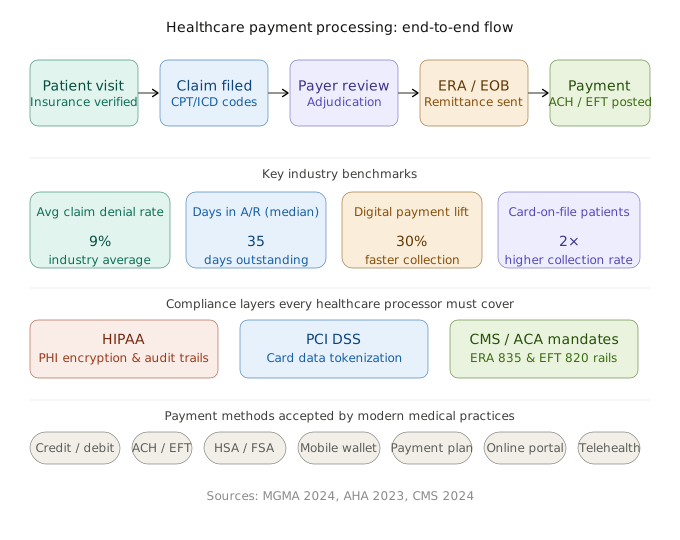
The revenue cycle in healthcare begins the moment a patient schedules an appointment and ends when every dollar owed for that visit is collected. Most providers think of payment processing as simply running a patient’s credit card or submitting a claim. In reality, it is a multi-step workflow that touches multiple stakeholders — the provider, the patient, the insurance payer, and often a clearinghouse in between.
The process begins with patient eligibility verification, where the practice confirms the patient’s insurance coverage and benefit levels before the visit occurs. After the clinical encounter, the medical coder assigns procedure codes (CPT codes) and diagnosis codes (ICD-10 codes) to the encounter. These codes are bundled into an electronic claim — typically an 837 file — and submitted either directly to the payer or through a clearinghouse.
The payer then adjudicates the claim, deciding what it will pay based on contracted rates, coverage policies, and medical necessity criteria. The payer sends back an Electronic Remittance Advice (ERA), also known as an 835 transaction, detailing what it paid and why. The billing team posts the payment, identifies any patient responsibility (co-pay, deductible, co-insurance), and sends a patient statement. Collection of the remaining balance completes the cycle.
Healthcare payment process: stage-by-stage breakdown
| Stage | Who Acts | Key Task | Typical Timeframe |
| Patient visit | Front desk | Eligibility check, copay collection | Day 0 |
| Claim submission | Biller / clearinghouse | Assign CPT & ICD codes | Day 1–3 |
| Payer adjudication | Insurance payer | Review, approve, or deny claim | Day 3–30 |
| ERA / EOB | Payer → practice | Electronic remittance sent | Day 14–45 |
| Payment posting | Billing team / software | Match payments, post adjustments | Day 15–50 |
| Patient balance | Patient | Pay copay, deductible, co-insurance | Day 30–90 |
Understanding each stage helps practices identify where revenue is leaking. Most denials occur at the claims submission or adjudication stage, while most patient balance losses occur at the final collection step.
HIPAA-compliant payment processing: what every provider must know
Medical payment processing is not like processing a payment at a retail store. Healthcare providers handle Protected Health Information (PHI) — which is tightly regulated under the Health Insurance Portability and Accountability Act (HIPAA). Any payment system, software platform, or vendor that touches patient data as part of the billing process must comply with HIPAA’s Security Rule and Privacy Rule.
This means payment processors and practice management platforms must use data encryption in transit and at rest, maintain detailed audit logs of data access, execute a Business Associate Agreement (BAA) with covered entities, implement role-based access controls to limit who sees patient financial data, and establish breach notification procedures. Violating HIPAA’s requirements can result in fines ranging from $100 to $50,000 per violation, depending on the level of negligence. The Department of Health and Human Services Office for Civil Rights actively investigates and penalizes non-compliant organizations.
Providers should also ensure their payment processing setup meets PCI DSS (Payment Card Industry Data Security Standard) requirements, which govern how credit and debit card data is stored, transmitted, and processed. Most modern healthcare payment platforms handle PCI compliance by tokenizing card data, meaning the actual card number never touches the provider’s systems. You can review the official PCI DSS framework at the PCI Security Standards Council website.
Insurance billing and claims management: reducing denials and accelerating reimbursement
For most outpatient practices, commercial insurance and government payers like Medicare and Medicaid account for the majority of revenue. Managing this revenue stream effectively requires a robust claims management process. Claim denial rates in the U.S. average around 9%, according to the Medical Group Management Association (MGMA), but top-performing practices keep denial rates below 5%.
Clean claim submission is the foundation of a high-performing billing operation. A clean claim is one submitted with all required fields correctly populated — patient demographics, provider NPI numbers, accurate diagnosis and procedure codes, and supporting documentation where required. Clearinghouse scrubbing tools catch common errors before claims reach the payer, dramatically reducing denial rates.
When denials do occur, a fast and organized appeals process determines whether that revenue is recovered. Studies show that practices that appeal denied claims recover 63% of initially denied amounts on average. Tracking denial reason codes systematically allows billing teams to identify patterns — for example, if a particular payer repeatedly denies a specific CPT code, that signals a contract or coding issue worth addressing proactively.
Medicare and Medicaid billing introduce additional layers of compliance, including coverage determination rules, modifiers, and prior authorization requirements. The Centers for Medicare & Medicaid Services (CMS) provides official billing guidelines at cms.gov, which should be a primary reference for any practice billing to government payers.
Patient payment collection: meeting patients where they are
The shift in healthcare cost burden toward patients has been dramatic. High-deductible health plans now cover more than 50% of insured Americans, according to the Kaiser Family Foundation. This means practices must increasingly function as consumer-facing payment businesses — collecting co-pays, deductibles, and co-insurance directly from patients.
Patient payment collection presents a different challenge than insurance billing. Patients expect the same digital payment convenience they experience in every other area of their lives. Offering only paper statements and phone-in payments leads to slow collection and high write-off rates. Modern practices are adopting a multi-channel approach: collecting co-pays at the point of service via card terminals and mobile wallets, offering online patient portals where patients can view and pay balances 24/7, sending automated text and email payment reminders, and providing payment plan options for larger balances. Card-on-file programs, where patients authorize the practice to charge their saved card after insurance processes, produce collection rates nearly twice as high as practices that rely on mailed statements alone.
Payment methods for medical practices: a comparison
| Payment Method | Processing Time | Typical Fee | Best For |
| Credit / debit card | 1–2 business days | 1.7%–3.5% | Copays & balances |
| ACH / EFT | 1–3 business days | $0.20–$1.50/txn | Large insurance payouts |
| HSA / FSA card | 1–2 business days | Same as debit | Eligible medical expenses |
| Mobile wallet | Same-day | 1.7%–2.9% | Contactless in-office |
| Payment plan / financing | Recurring monthly | Varies by platform | High-balance patients |
| Online patient portal | 1–2 business days | 1.7%–3% | Remote billing |
HSA and FSA cards are particularly important to accept. As high-deductible plans become more common, more patients use tax-advantaged health savings accounts to pay medical bills. Practices that cannot accept HSA/FSA cards lose those patients to competitors who can.
Leading payment processing platforms for healthcare providers
Stripe
Stripe has emerged as a popular option for digital health companies and modern medical practices, building custom payment workflows. Stripe offers HIPAA-eligible data handling under a BAA, robust APIs for embedding payments into patient-facing applications, and support for ACH, cards, and digital wallets. Its healthcare-specific features include subscription billing for membership-based practices and strong developer tooling for telehealth integrations.
Square for Healthcare
Square provides an accessible point-of-sale and invoicing platform suited for smaller practices, therapy offices, and wellness clinics. Square’s card readers support contactless payments and chip cards, and the platform integrates with a range of practice management systems. It offers next-business-day deposits, transparent flat-rate pricing, and a free card reader to get started quickly.
InstaMed (JP Morgan Chase)
InstaMed, now part of JPMorgan Chase, is purpose-built for healthcare payment processing at scale. It handles both payer-to-provider electronic funds transfers (EFTs) and patient payment collection on a unified platform. InstaMed is widely used by hospitals, large medical groups, and health systems that need deep integration with billing and EHR systems. Its network connects directly to commercial payers and government programs, enabling real-time eligibility checks and same-day payment posting.
Waystar
Waystar is a revenue cycle management platform that combines claims management, remittance processing, and patient payment collection into a single workflow engine. It is particularly strong for practices dealing with complex payer mixes and high denial volumes. Waystar’s denial prediction tools use machine learning to flag claims likely to be denied before submission, enabling billers to proactively address issues.
Telehealth payment processing: closing the digital billing loop
Telehealth surged during the COVID-19 pandemic and has remained a permanent part of how many practices deliver care. Telehealth payment processing introduces specific requirements: collecting payment before or at the time of a virtual visit, processing across state lines where coverage rules may differ, and integrating billing into the virtual care platform.
The good news is that CMS permanently expanded telehealth reimbursement policies for Medicare, and most commercial payers now offer telehealth coverage. For billing purposes, telehealth visits use standard CPT codes with specific place-of-service codes (95 for audio-video, 02 for other telehealth settings) and modifiers. The AMA provides a complete telehealth coding guide at ama-assn.org/practice-management/digital/ama-telehealth-quick-guide. Practices should also implement card-on-file or pre-payment workflows for telehealth, since no-show rates are higher for virtual visits and collecting after the fact is more difficult.
Choosing the right payment processor for your practice
Selecting a healthcare payment processor requires evaluating several dimensions beyond just transaction fees. HIPAA compliance and willingness to sign a BAA are non-negotiable baselines — any processor that declines to sign a BAA should be eliminated from consideration immediately. Beyond compliance, integration with your existing electronic health record (EHR) and practice management system determines how much manual work your billing team faces daily. A processor with native integration to your EHR eliminates duplicate data entry and payment reconciliation headaches.
Pricing structures vary significantly. Some processors charge a flat percentage per transaction (typically 1.7% to 3.5% for card payments), while others charge interchange-plus pricing, which passes the actual interchange cost through with a fixed markup. For practices with high ACH or EFT volume from insurance payers, processors with low per-transaction ACH fees (often $0.20 to $1.50) represent significant savings over card-rate pricing. Patient experience features — mobile payment links, text-to-pay, online portals, and payment plan tools — should also weigh heavily, since these directly affect collection rates and patient satisfaction scores.
Conclusion: Payment Processing is Clinical Infrastructure
For too long, healthcare payment processing has been treated as a back-office function — something that happens after the real work of patient care is done. That view is no longer sustainable. In today’s healthcare environment, where patients bear more of the financial burden, payer rules grow more complex, and digital expectations are universal, payment processing is clinical infrastructure.
Practices that invest in HIPAA-compliant, integrated, multi-channel payment systems collect more revenue, lose fewer claims to denials, and deliver a better patient financial experience. Those that rely on outdated workflows — paper statements, phone-in payments, manual claim submissions — are quietly bleeding revenue they earned but cannot collect.
The technology exists today to automate much of the revenue cycle, from eligibility verification through final payment posting. The question for every healthcare provider is not whether to modernize payment processing, but how quickly they can afford not to.
Frequently asked questions
What is the difference between a clearinghouse and a payment processor in healthcare?
A clearinghouse is a company that acts as an intermediary between healthcare providers and insurance payers. It receives electronic claims from the provider, scrubs them for errors, translates them into the payer’s required format, and routes them to the correct payer. A payment processor, by contrast, handles the actual movement of money — whether from an insurance payer via EFT or from a patient via credit card, ACH, or digital wallet. Many modern healthcare billing platforms combine both functions, but they serve distinct roles in the revenue cycle.
Do payment processors need to sign a HIPAA Business Associate Agreement (BAA)?
Yes — any vendor that handles, transmits, or stores Protected Health Information (PHI) as part of your payment workflow is a Business Associate under HIPAA and must sign a BAA with your practice. This includes payment processors that receive patient names, dates of service, or diagnosis information alongside payment data. A processor that refuses to sign a BAA is not HIPAA-compliant and should not be used for healthcare payment processing.
How can my practice reduce insurance claim denials?
Denial reduction starts before the claim is ever submitted. Verifying patient eligibility in real time on the day of service eliminates coverage-based denials. Using a clearinghouse with claim scrubbing tools catches coding errors, missing modifiers, and demographic mismatches before the payer sees the claim. Tracking denial reason codes by payer and code allows billing teams to fix systemic issues rather than correcting errors claim by claim. Practices that implement pre-authorization workflows for services requiring prior approval also see significant reductions in medical necessity denials.
What payment options should a medical clinic offer patients?
At minimum, a medical clinic should accept credit and debit cards (including contactless and chip), ACH bank transfers, HSA and FSA cards, and online portal payments. Adding text-to-pay and email payment link capabilities dramatically increases the speed and rate of patient balance collection. For practices treating patients with larger out-of-pocket balances — orthopedics, fertility, dental, dermatology — offering financing or payment plan options through platforms like CareCredit or PatientFi reduces write-offs and increases case acceptance. The goal is to remove every friction point between a patient’s decision to pay and the actual payment.