


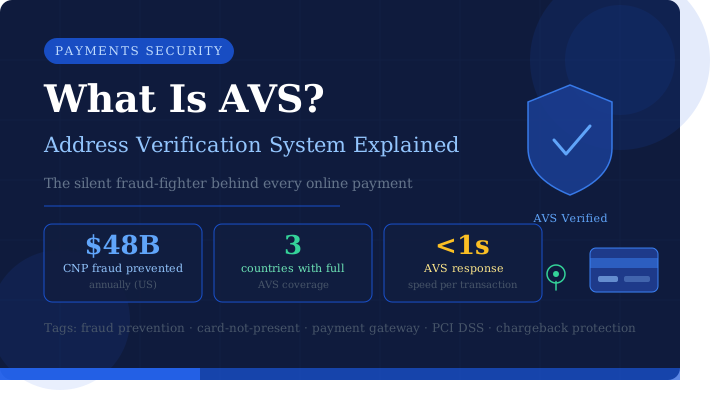
Every time you shop online and type in your billing address, something quiet happens in the background. A fraud-prevention tool called the Address Verification System (AVS) springs into action. It checks whether the address you entered matches the one your bank has on file. It sounds simple — and it is. But this single check prevents billions of dollars in card-not-present fraud every year. If you are a merchant, payment processor, or curious consumer, understanding how AVS works — and why it matters — can directly impact your bottom line and your customers’ trust.
In this Article
What Is the Address Verification System (AVS)?
The Address Verification System, commonly abbreviated as AVS, is a security feature used in card-not-present (CNP) transactions. It was developed to help merchants and payment processors verify that the billing address a customer provides matches the address registered with the card issuer — typically the customer’s bank or credit union.
AVS is most widely used in the United States, Canada, and the United Kingdom. It applies primarily to credit card and debit card transactions made online, over the phone, or through mail orders — situations where the physical card is not swiped or tapped at a terminal. When a customer completes a purchase, the payment gateway sends the billing address and ZIP code to the card network for verification. The card issuer then compares those details to its records and sends back a response code.
| 💡 Key Fact: AVS does not block transactions on its own. It only provides a verification signal. The final decision — to approve, review, or decline — belongs to the merchant or payment processor. |
How Does Address Verification Work Step-by-Step?
The process begins the moment a customer enters their billing information at checkout. The merchant’s payment gateway collects the street address and ZIP code and sends those details — encrypted — alongside the transaction request to the card network (Visa, Mastercard, American Express, or Discover). The card network forwards this data to the customer’s issuing bank. The bank looks up the address on file and generates an AVS response code. That code travels back through the network to the merchant within milliseconds.
The merchant’s payment system then interprets that code. Depending on the result, the system may automatically approve the transaction, flag it for manual review, or decline it outright. Most modern payment gateways allow merchants to configure custom rules — for example, automatically declining any transaction with a full address mismatch.
AVS Response Codes: A Complete Reference
The following table lists the most common AVS response codes returned by card issuers:
| AVS Code | Match? | Result Type | What It Means |
| Y | Y | Full Match | Both address and ZIP match |
| A | N | Partial Match | Address matches, ZIP does not |
| Z | N | Partial Match | ZIP matches, address does not |
| N | N | No Match | Neither address nor ZIP match |
| U | — | Unavailable | Issuer does not support AVS |
| E | — | Error | Transaction ineligible for AVS |
| S | — | Not Supported | Issuer does not participate |
Note: Specific codes may vary slightly by card network and issuing bank.
Why Does AVS Matter for Merchants?
AVS is a frontline fraud defense tool for any business that accepts card-not-present payments. Without it, fraudsters who have stolen card numbers can attempt purchases freely — unless additional security layers catch them. With AVS enabled, a fraudster who does not know the cardholder’s billing address is immediately flagged.
Beyond fraud prevention, AVS has direct financial consequences for merchants. Major card networks, including Visa and Mastercard, offer lower interchange rates for transactions that use AVS. These “qualified” transactions are considered lower risk, which translates to real savings on processing fees at scale. For a business processing thousands of transactions daily, the difference can be significant.
There is also the chargeback factor. Chargebacks — when a customer disputes a charge and the bank reverses the payment — are costly and time-consuming for merchants. Using AVS as part of a broader fraud prevention strategy helps reduce fraudulent chargebacks. It also provides documentation that the merchant took reasonable steps to verify the transaction, which can support chargeback dispute cases. According to Chargebacks911, merchants who implement multi-layer authentication including AVS see measurably fewer fraud-related disputes.
AVS vs. CVV: Understanding the Difference
Merchants often use AVS alongside CVV (Card Verification Value) verification, but the two tools work differently. CVV is the three- or four-digit code printed on the physical card. It confirms that the person making the purchase has the physical card in hand. AVS, on the other hand, confirms that the billing address submitted matches the bank’s records. Together, they create a layered authentication approach that is far stronger than either tool alone.
Here is a direct comparison of how AVS and CVV differ:
| Feature | AVS | CVV |
| What it checks | Billing address + ZIP code | 3–4 digit security code on card |
| Where it lives | Card issuer’s database | Physically printed on the card |
| Fraud type prevented | Card-not-present billing fraud | Physical card theft/skimming |
| Required by PCI DSS? | Recommended | Merchants cannot store after auth |
| Works offline? | No | No (online verification) |
| Chargeback protection? | Partial | Yes (with proper documentation) |
Using only one of these verification methods leaves gaps. A thief who steals physical card data from a breach may know the CVV but not the billing address — making AVS the more effective check in that scenario. Conversely, phishing attacks that capture login credentials may yield the billing address but not the CVV from the physical card. This is precisely why industry best practices recommend using both.
AVS and the Major Payment Networks
Visa
Visa has supported AVS since the early 1990s and uses a standardized set of response codes across its global network. Visa’s AVS implementation is consistent across the US, but address formats vary internationally, which can lead to mismatches for legitimate overseas customers.
Mastercard
Mastercard’s AVS system works similarly and is integrated into its fraud scoring tools. Mastercard uses AVS data as one of several signals within its Decision Intelligence platform, which applies machine learning to real-time transaction risk scoring.
American Express
American Express has its own AVS system with slightly different response codes. Because AmEx acts as both the card network and the issuer for many of its cards, the verification process can be more direct and the data quality higher. AmEx also offers enhanced fraud tools for merchants through its OptBlue program.
Discover
Discover supports AVS primarily within the United States. International transactions on Discover-issued cards may not return AVS responses, which is a limitation merchants should factor into their fraud rules for cross-border payments.
The Limitations of AVS You Need to Know
No fraud prevention tool is perfect, and AVS has real limitations that merchants must understand. The most notable is its geographic limitation. AVS works well in the United States, Canada, and the UK. However, many international issuers — particularly in Asia, Latin America, and Africa — do not support AVS. This means that a “U” (unavailable) response is common for legitimate international customers, and declining all such transactions would result in a high rate of false positives and lost revenue.
Another limitation is that AVS only checks the address and ZIP code — it cannot verify the identity of the person making the purchase. A fraudster who obtains both the card number and the billing address (through data breaches, phishing, or social engineering) can easily pass an AVS check. This is why AVS should never be used as the sole fraud prevention tool. It is most powerful as one layer within a multi-factor fraud prevention strategy that may also include CVV checks, device fingerprinting, behavioral analytics, and 3D Secure authentication.
PCI DSS compliance guidelines, maintained by the PCI Security Standards Council, recommend AVS as part of a comprehensive payment security framework, though they do not mandate it as a standalone requirement.
| ⚠️ AVS Limitation Alert: Roughly 30–40% of international transactions return an “unavailable” AVS code — not because something is wrong, but because the issuing bank simply does not support the system. Blanket declines for non-US cards will hurt your conversion rate. |
AVS Best Practices for Online Merchants
Getting the most out of AVS requires thoughtful configuration. Merchants should start by defining clear rules for each AVS response code rather than using a binary accept-or-decline approach. A full match (“Y” code) can be approved automatically. A partial match (“A” or “Z” code) might trigger a manual review or an additional verification step. A full mismatch (“N” code) on a high-value transaction warrants a decline or escalation.
It is equally important to avoid over-filtering. Declining all transactions with partial matches or “unavailable” responses will eliminate many legitimate purchases, especially from international customers or individuals who recently moved and have not updated their billing address. A smart approach layers AVS results alongside order velocity checks, IP geolocation data, and purchase history to build a fuller picture of transaction risk.
Finally, merchants should review their AVS match rates regularly. A sudden drop in match rates — or a spike in “N” codes — can signal an active fraud campaign targeting your store. Many payment processors, including Stripe and Adyen, offer dashboards and rule engines that incorporate AVS data into automated fraud decisioning at scale.
Conclusion
The Address Verification System is one of the most widely deployed fraud prevention tools in the payments industry — and for good reason. It adds a meaningful layer of verification to card-not-present transactions without adding friction for the customer. For merchants, it can reduce fraud losses, lower interchange fees, and strengthen chargeback defense. For consumers, it adds peace of mind that their card information is being cross-checked before a transaction clears.
That said, AVS is not a silver bullet. It works best when combined with CVV verification, behavioral analytics, and authentication tools like 3D Secure. As fraud tactics evolve, merchants must evolve their defenses too. Understanding what AVS is — and what it cannot do — is the first step toward building a payment security strategy that actually holds up.
Frequently Asked Questions (FAQs)
1. Does AVS affect whether a transaction is approved or declined?
AVS itself does not approve or decline transactions. It returns a response code to the merchant, who then decides — based on their configured rules — whether to proceed with the transaction. Some merchants auto-decline full mismatches; others manually review them. The final authority rests with the merchant’s fraud rules, not the AVS system itself.
2. Why does AVS sometimes fail on legitimate transactions?
Several scenarios can cause AVS mismatches for legitimate customers. A customer may have recently moved and not updated their billing address with the bank. They may be using a gift card or prepaid card that lacks a registered address. International cardholders may trigger an “unavailable” response if their bank does not support AVS. In all these cases, the transaction may be entirely legitimate even though AVS returns a non-matching code.
3. Is AVS the same as 3D Secure authentication?
No, these are two different tools. AVS checks the billing address entered at checkout against the issuer’s records. 3D Secure (such as Verified by Visa or Mastercard Identity Check) is a protocol that redirects the cardholder to their bank for additional authentication — typically a one-time password or biometric check. 3D Secure shifts liability for fraudulent chargebacks to the issuer; AVS does not offer that liability shift on its own.
4. Do all countries support AVS?
No. AVS is most reliably supported in the United States, Canada, and the United Kingdom. Many card issuers in Europe, Asia, Latin America, and Africa either do not support AVS or return “unavailable” codes regardless of whether the address matches. Merchants selling internationally need to account for this limitation in their fraud rules to avoid falsely declining legitimate foreign orders.